A Field sheet entry
Gargoyle vs Grotesque: Strictly, a Gargoyle Is a Waterspout
The problem once the water of a high roof was gathered in gutters, instead of dripping from the projecting cornices onto the street, it had to be let out and thrown clear of the walls below.
Built, Mapped & Planted Issued
TL;DR
In the strict sense, a gargoyle is a waterspout: usually a projecting stone, often carved as a beast, that carries roof water out and drops it clear of the wall. Viollet-le-Duc's dictionary of French architecture uses the word that way for plain and lead spouts too. This page calls a carved figure with no water channel a grotesque.
| Name | Gargoyle (French gargouille); the entry also gives gargolle, guivre, canon and lanceur |
|---|---|
| Category | Reading a Facade: carved features sorted by what they do |
| Where it appears | At the foot of roofs and gutters, and at the heads of buttresses, on churches and houses |
| Original problem | Letting gutter water off a roof in many thin streams thrown clear of the walls, where before it had dripped from the projecting cornices onto the street |
| Sources | Viollet-le-Duc, entry Gargouille (tome 6); museum records of Meryon's etching Le Stryge |
This block as data (CSV) where this data comes from
Data: Eugène Viollet-le-Duc, Dictionnaire raisonné de l'architecture française du XIe au XVIe siècle, tome 6 (1854–1868), entry Gargouille
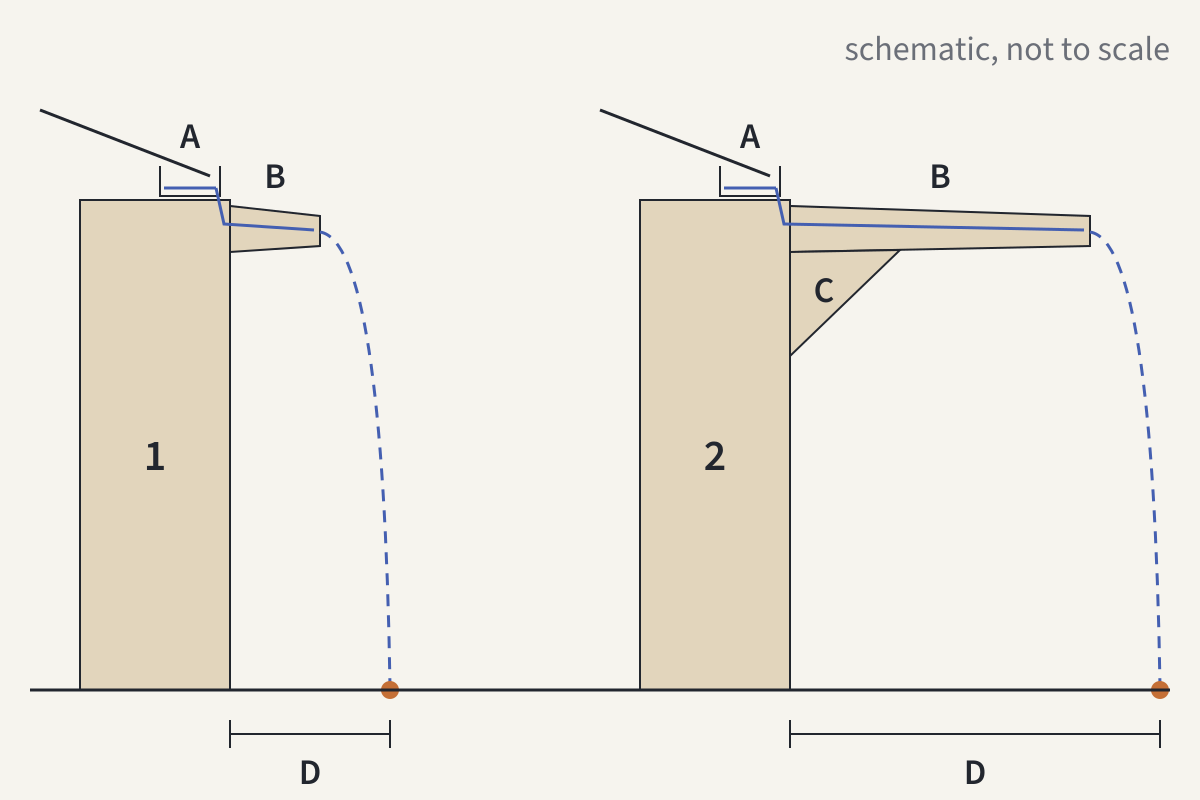
"Where the water from a gargoyle lands (schematic)" by Built, Mapped & Planted, https://builtmappedandplanted.com/details/gargoyle-vs-grotesque/ — CC BY 4.0, https://creativecommons.org/licenses/by/4.0/
Data: Eugène Viollet-le-Duc, Dictionnaire raisonné de l'architecture française du XIe au XVIe siècle, tome 6 (1854–1868), entry Gargouille, pp. 21–23
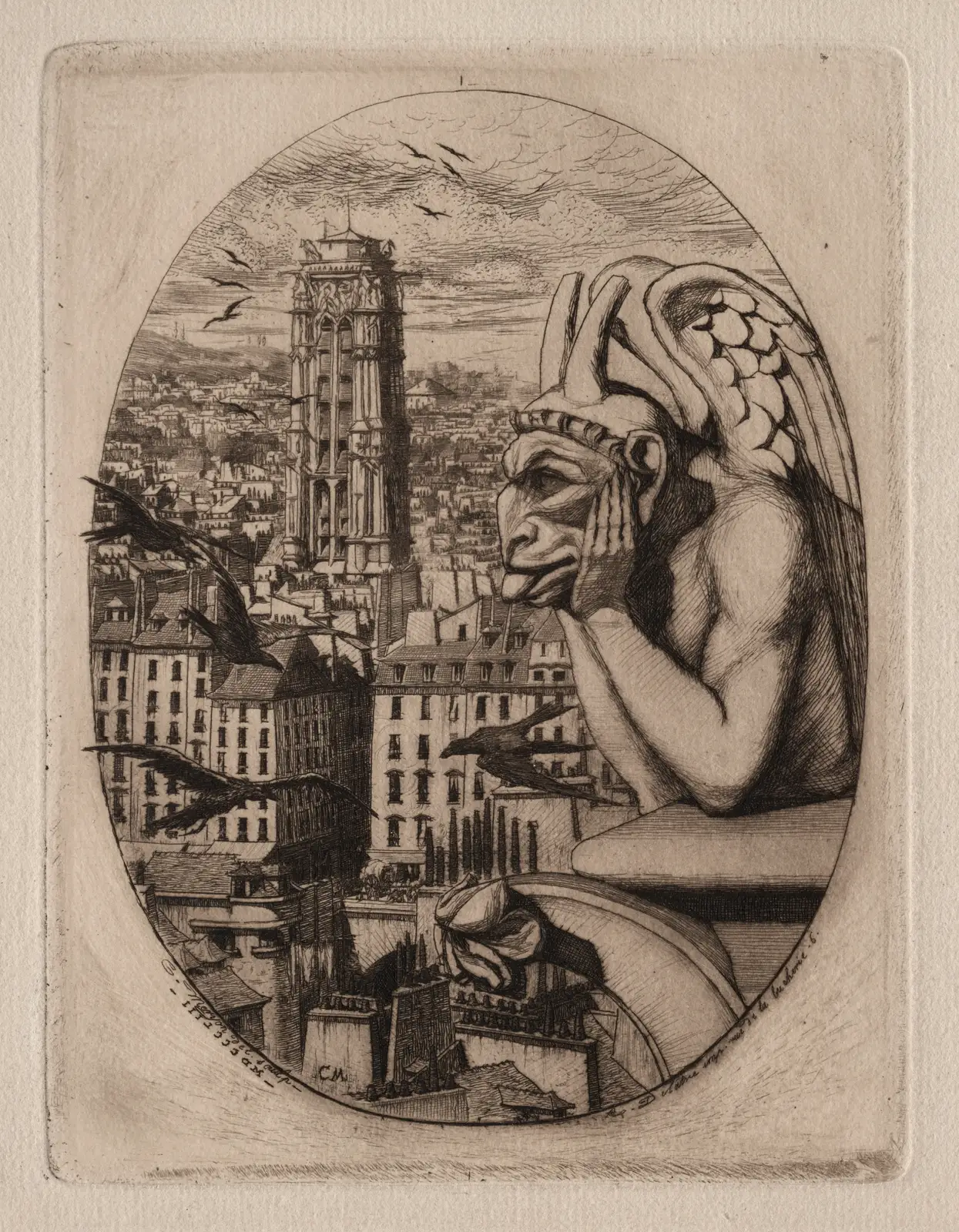
"Etchings of Paris: The Gargoyle (Le Stryge), by Charles Meryon" by Charles Meryon — https://commons.wikimedia.org/wiki/File:Charles_Meryon_-_Etchings_of_Paris-_The_Gargoyle_-_1940.889_-_Cleveland_Museum_of_Art.jpg — CC0 1.0 (https://creativecommons.org/publicdomain/zero/1.0/)
The drawing compares a short spout with a long one carried on a bracket: the farther the spout reaches, the farther from the wall its water lands. The picture is Charles Meryon's etching of a horned creature on Notre-Dame in Paris, leaning on a stone ledge with no water channel drawn.
Basis Gutter, spout, corbel and fall arranged as described in Viollet-le-Duc's entry Gargouille (tome 6, pp. 21–23); a schematic with no dimensions.
Legend: letters and numbers on the drawing
- 1 short spout set straight into the wall
- 2 long spout carried on a corbel
- A gutter at the foot of the roof
- B spout, with its water channel
- C corbel, a stone bracket under the spout
- D distance from the wall face to where the water lands
Below a carved stone beast on a church roof, the wall can be streaked where its mouth points. The streak is a clue to the stone's job. In the strict sense used here, a gargoyle is a spout, and the beast is how it was dressed. The horned creature in Meryon's print is drawn with no spout at all, and that missing spout is the whole distinction.
What makes a gargoyle a gargoyle?
Eugène Viollet-le-Duc's Dictionnaire raisonné de l'architecture française, published from 1854 to 1868, gives the gargouille its own entry in volume 6. The entry opens with other names for the same thing: gargolle, guivre, canon and lanceur, the last of which this page translates roughly as “thrower.” Gutters, and with them gargoyles, were placed at the foot of roofs only from about the start of the 13th century, according to the entry. Before that, roof water dripped from the overhanging cornices straight onto the street.
The change came from dividing the water. In his words, « Bientôt les architectes du XIIIe siècle reconnurent qu'il y avait un avantage considérable à diviser les chutes d'eau. Cela, en effet, évitait les longues pentes dans les chéneaux et réduisait chacune des chutes à un très-mince filet d'eau ne pouvant nuire aux constructions inférieures » (tome 6, p. 21).
In this page's translation, that reads: “Soon the architects of the 13th century recognized that there was a considerable advantage in dividing the falls of water. This avoided long slopes in the gutters and reduced each fall to a very thin stream of water that could do no harm to the building below.”
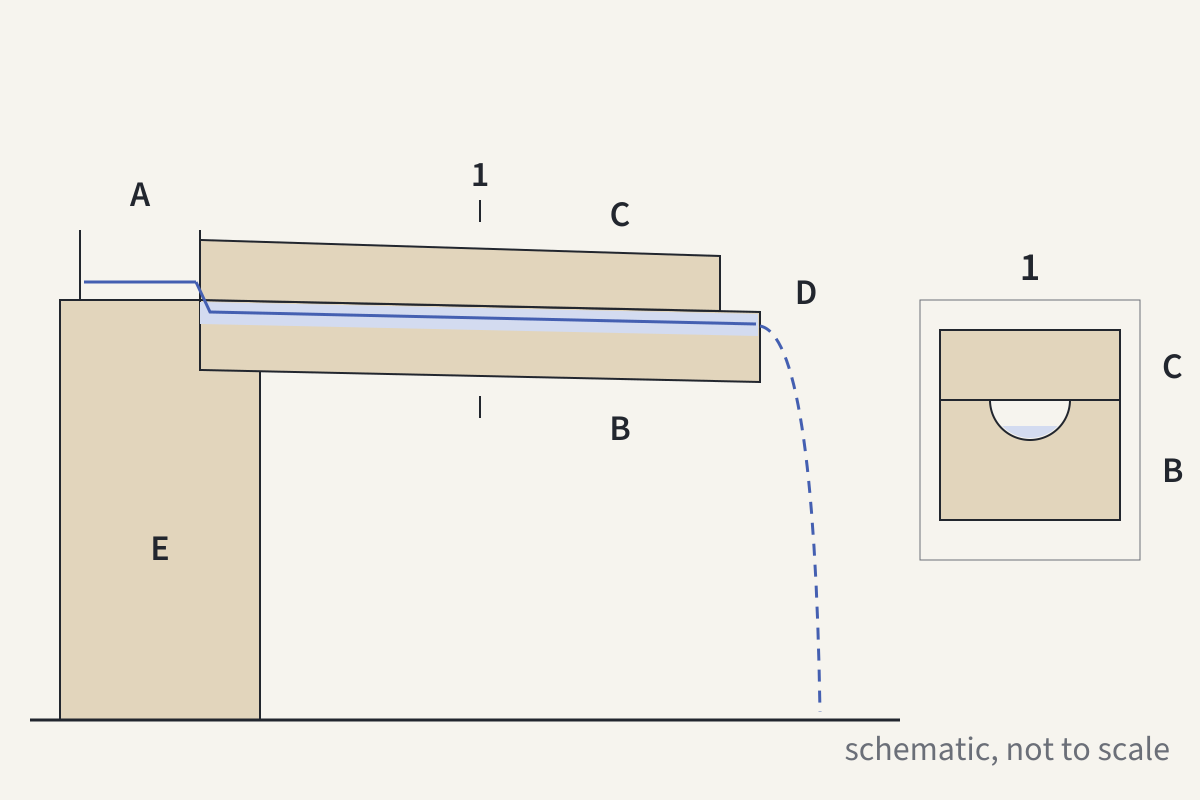
A gargoyle in section: water leaves the gutter, runs along a channel cut in the lower stone under a covering stone, and drops from the mouth. The inset cuts across the spout to show the two stones.
Basis Two-course construction (one course forming the channel, the other the cover) from Viollet-le-Duc's description of the Laon gargoyles, tome 6, p. 21; a schematic drawn from that description, not from his figure.
Legend: letters and numbers on the drawing
- A gutter on the wall top
- B lower course, cut as an open channel
- C upper course, laid over the channel as a cover
- D mouth, where the water leaves the spout
- E wall
- 1 cross section through the spout
"A stone spout built of two courses (schematic)" by Built, Mapped & Planted, https://builtmappedandplanted.com/details/gargoyle-vs-grotesque/ — CC BY 4.0, https://creativecommons.org/licenses/by/4.0/
Data: Eugène Viollet-le-Duc, Dictionnaire raisonné de l'architecture française du XIe au XVIe siècle, tome 6 (1854–1868), entry Gargouille, p. 21
Gargoyle or grotesque: which is which?
The test is the water channel, not the carving. Viollet-le-Duc counts a spout as a gargouille whether or not it was sculpted. In places out of sight, he notes, gargoyles were only roughed out, and from the second half of the 16th century some were plain stone tubes shaped like cannon. Lead gutters had lead gargoyles too, and he draws a 15th-century one of beaten lead on a house corner at Vitré.
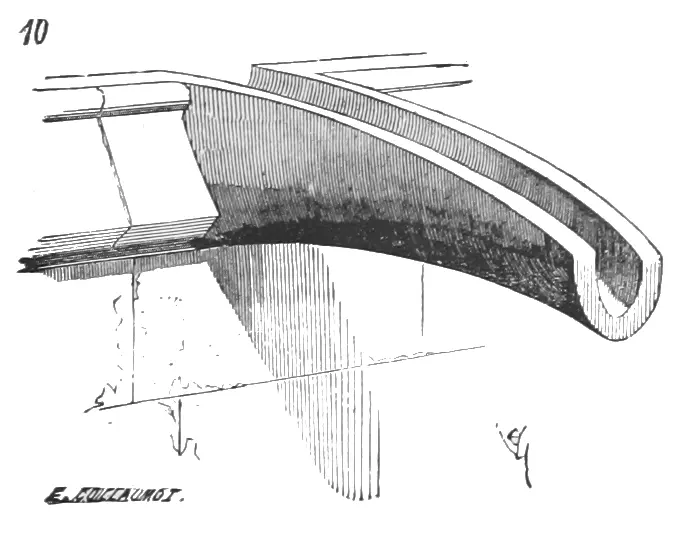
Viollet-le-Duc's figure 10, which his note places at Notre-Dame in Paris: a spout only roughed out, an open trough of stone with no beast at all.
"Gargouille, figure 10 (uncarved spout, Notre-Dame), from Dictionnaire raisonné de l'architecture française, tome 6" by Eugène Viollet-le-Duc — https://commons.wikimedia.org/wiki/File:Illustration_fig10_6_35.png — Public Domain (US: published before 1931; EU: author died 1879, more than 70 years ago (life plus 70 years))
A carved creature with no channel is what this page calls a grotesque. That word does not appear in the entry, so this half of the distinction is the usage of this page, not his.
Some catalog records use the looser sense. On their Commons file pages, the Cleveland Museum of Art titles Meryon's print Etchings of Paris: The Gargoyle, and the Rijksmuseum describes its subject as a vampire figure “als waterspuwer,” as a waterspout. The National Gallery of Art's record titles the print Le stryge (The Vampire).
How Viollet-le-Duc drew one
His first figure shows a gargoyle from Laon cathedral of about 1220. These early spouts, he writes, were broad, few in number and built of two courses, one forming the channel and the other the cover. Even so, he adds, they already took the shape of fantastic animals, heavily cut.
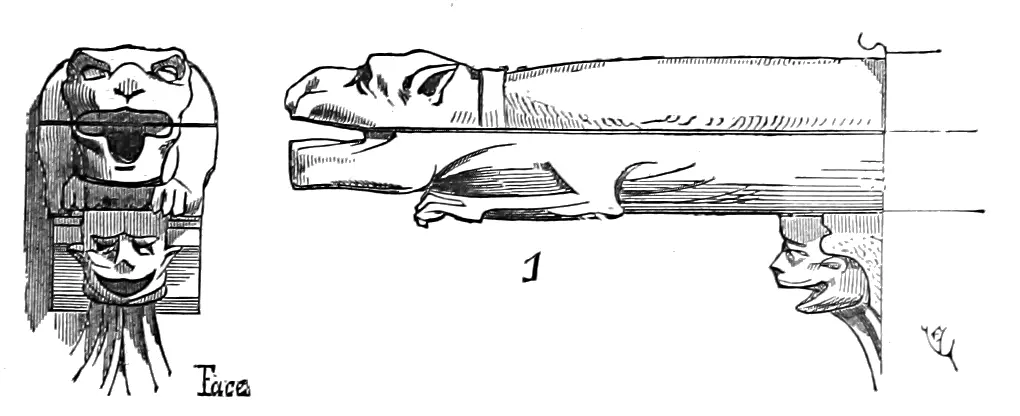
The first figure in the entry: the early Laon spout in side and front view, with the joint between its two stones running along its length and an open mouth at the end of the channel.
"Gargouille, figure 1 (Laon), from Dictionnaire raisonné de l'architecture française, tome 6" by Eugène Viollet-le-Duc — https://commons.wikimedia.org/wiki/File:Illustration_fig1_6_29.png — Public Domain (US: published before 1931; EU: author died 1879, more than 70 years ago (life plus 70 years))
Are the Notre-Dame creatures medieval? For the spouts, the entry says gargoyles were used systematically in Paris around 1240. At that cathedral it places short ones on upper cornices remade around 1225, and longer ones on corbels at the ends of the water channels on the nave's flying buttresses. For the horned figure in Meryon's print, no source read for this page gives a carving date, and the museum records date only the etching, to 1853.
Spout, ornament, or symbol?
The order of questions matters. Before asking what a carved beast means, ask whether it drains water, adds weight or finishes an edge; only then turn to symbolism. Each example below is sorted as a working spout, a spout no longer working, or mainly symbolic. A present use is not taken as proof of how a feature began.
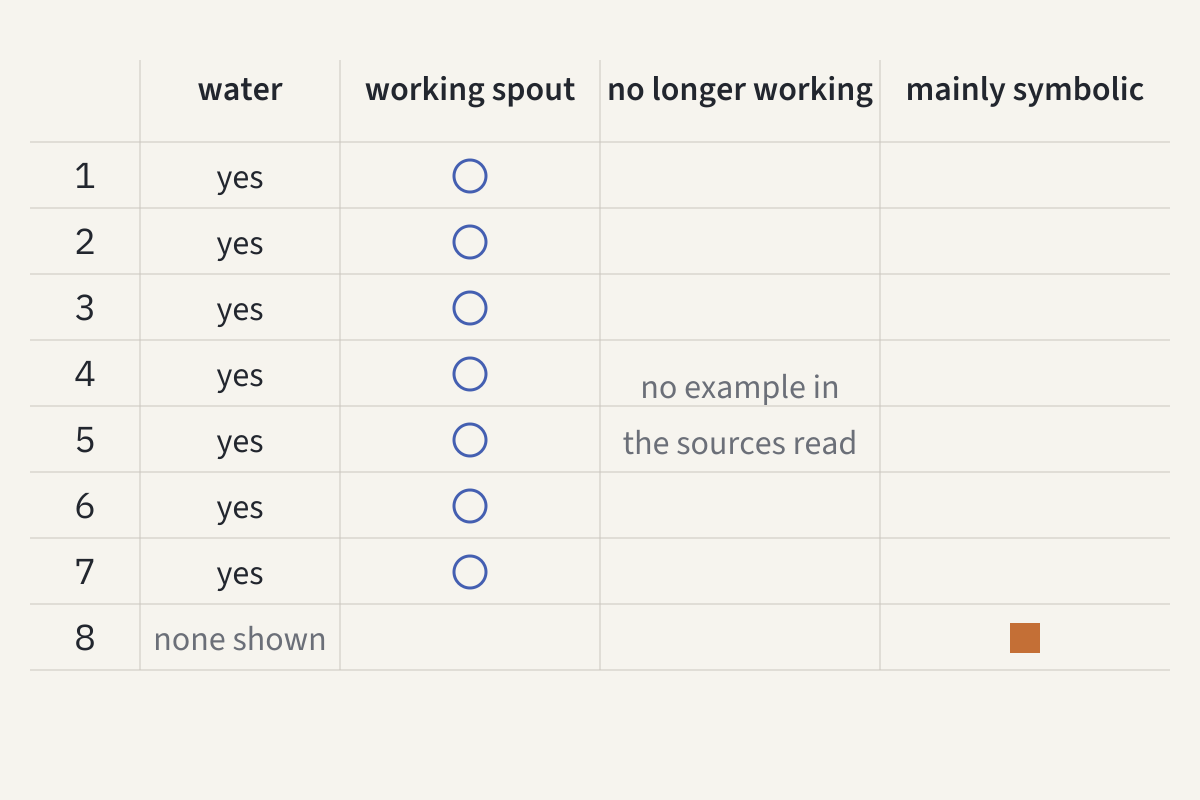
Eight examples, each sorted by what it does. Hollow circles are spouts as Viollet-le-Duc described them, and the square is a figure that carries no water as drawn.
Basis Rows 1 to 7 from Viollet-le-Duc's entry Gargouille (tome 6, pp. 21–28) with his figure numbers; row 8 from Meryon's etching; one row per example, matching the table below.
Legend: letters and numbers on the drawing
- 1 early gargoyles, Laon cathedral
- 2 short gargoyles on the upper cornices, Notre-Dame, Paris
- 3 gargoyles at the ends of the water channels on the nave flying buttresses, Notre-Dame
- 4 whole-animal gargoyles, Sainte-Chapelle, Paris
- 5 temporary spout kept for good, upper nave, Amiens cathedral
- 6 uncarved spouts out of sight, Notre-Dame
- 7 lead spout on a house corner, Vitré
- 8 horned creature in Meryon's etching
"Eight examples sorted by what they do" by Built, Mapped & Planted, https://builtmappedandplanted.com/details/gargoyle-vs-grotesque/ — CC BY 4.0, https://creativecommons.org/licenses/by/4.0/
Data: Eugène Viollet-le-Duc, Dictionnaire raisonné de l'architecture française du XIe au XVIe siècle, tome 6 (1854–1868), entry Gargouille, pp. 21–28; Charles Meryon's etching (Cleveland Museum of Art 1940.889, CC0)
| Row | Example | Water | Class | Evidence |
|---|---|---|---|---|
| 1 | Laon cathedral, about 1220 | yes | working spout | two courses, channel and cover; entry p. 21, fig. 1 |
| 2 | Notre-Dame, upper cornices | yes | working spout | cornices remade about 1225; entry p. 22, fig. 2 |
| 3 | Notre-Dame, nave flying buttresses | yes | working spout | long spouts on corbels; entry pp. 22–23, fig. 3 |
| 4 | Sainte-Chapelle, Paris | yes | working spout | heads turned to throw water off the buttress corners; entry p. 23, fig. 4 |
| 5 | Amiens cathedral, upper nave | yes | working spout | fed from the gutter by an almost vertical pipe; entry p. 24, fig. 5 |
| 6 | Notre-Dame, out of sight | yes | working spout | roughed out, not carved; entry pp. 26–27, fig. 10 |
| 7 | House corner, Vitré | yes | working spout | 15th-century beaten lead; entry p. 28, fig. 11 |
| 8 | Meryon's etching | none shown | mainly symbolic | chin on hands on a ledge, no channel drawn; no meaning given in the sources read |
Download the eight examples with sources (CSV) (where this data comes from) Data: Eugène Viollet-le-Duc, Dictionnaire raisonné de l'architecture française du XIe au XVIe siècle, tome 6 (1854–1868), entry Gargouille, fr.wikisource transcription, read 2026-11-18; Cleveland Museum of Art record 1940.889 via Wikimedia Commons, read 2026-11-18
Rows 1 to 7 record the spouts as Viollet-le-Duc described them in the 1860s. Their present state is not checked here. The “no longer working” column stays empty because no source read for this page gives an example. Reading by function also means a feature can look like one thing and be another, as a bricked-up window shows in the window tax.
Row 5 is a working spout with a history. Gothic builders, he explains, left temporary spouts to drain the vaults while the roofs were still unfinished. The Amiens spout is one of these, kept for good and later fed from the finished gutter through an almost vertical pipe.
Why carve a spout as a beast?
Once the falls were divided, the spouts multiplied, and that is where the sculpture came in. The entry puts it this way: « On multiplia donc les gargouilles ; en les multipliant, on put les tailler plus fines, plus sveltes, et les sculpteurs s'emparèrent de ces pierres saillantes pour en faire un motif de décoration des édifices » (tome 6, p. 21).
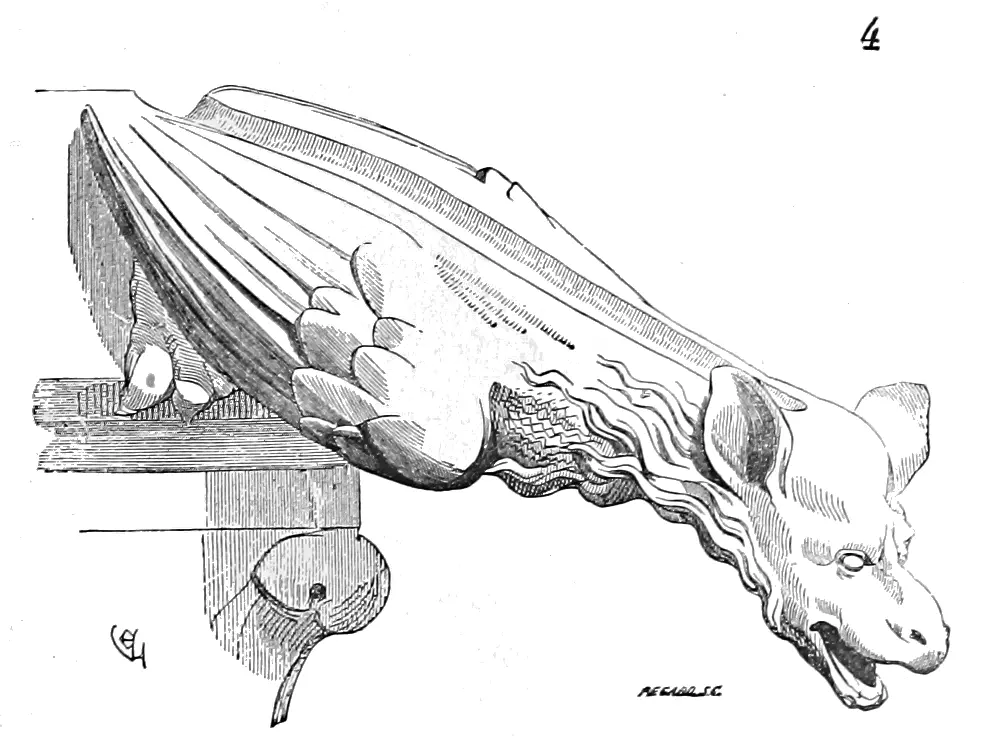
Viollet-le-Duc's figure 4: a Sainte-Chapelle spout drawn as a whole winged animal clinging to the wall, its mouth open at the end of the channel.
"Gargouille, figure 4 (Sainte-Chapelle), from Dictionnaire raisonné de l'architecture française, tome 6" by Eugène Viollet-le-Duc — https://commons.wikimedia.org/wiki/File:Illustration_fig4_6_31.png — Public Domain (US: published before 1931; EU: author died 1879, more than 70 years ago (life plus 70 years))
In this page's translation: “So the gargoyles were multiplied; in multiplying them, they could be cut finer and slimmer, and the sculptors took hold of these projecting stones to make them a motif for decorating buildings.” At the Sainte-Chapelle in Paris, the entry continues, the spouts became whole animals whose heads turn to throw the water as far as possible from the corners of the buttresses.
On why the spouts became beasts, the entry gives that working sequence rather than a meaning. Once spouts were many and slender, sculptors took them over. Viollet-le-Duc called the variety of their forms prodigieuse and wrote that he knew of no two alike in France (p. 22).
What is a chimera on a church? In the dictionary entry, chimères are a later shape for spouts. In the second half of the 16th century, he writes, sculptors gave up the old forms “pour adopter des figures de chimères rappelant certaines figures antiques” (p. 26), to take up chimera figures recalling certain ancient ones. The sources read here do not give that word to the Notre-Dame figures, so this page does not either.
Gargoyles still at work
A working gargoyle is easiest to read in the rain. A photograph taken along the side of Notre-Dame in Paris on 5 September 2013, after a rainstorm, shows a row of carved spouts projecting from the buttresses. Water drops from their mouths and falls clear of the wall below.
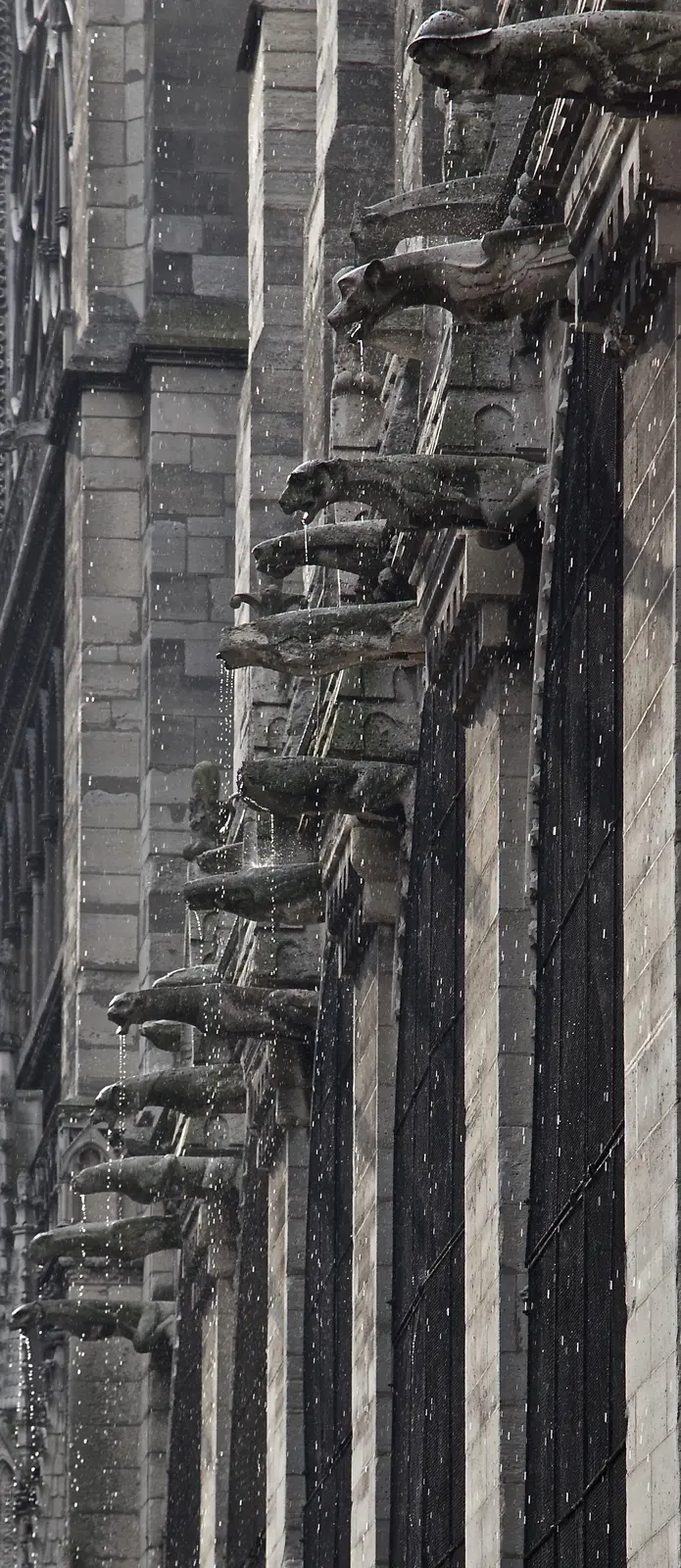
Gargoyles along the side of Notre-Dame in Paris after a rainstorm, photographed in September 2013. Drops falling from the mouths show the spouts still carrying water away from the wall.
"Notre Dame Gargoyles as rain gutters" by David.Clay.Photography — https://commons.wikimedia.org/wiki/File:Notre_Dame_Gargoyles_as_rain_gutters.jpg — CC BY-SA 4.0 (https://creativecommons.org/licenses/by-sa/4.0/)
A metal downpipe fixed beside or below a gargoyle is part of the building's maintenance signature, the visible clues that show who looks after a structure and how it has been kept up over time. Such a pipe shows that the drainage has been worked on, but not by itself what was done.
At Amiens, the pipe in Viollet-le-Duc's account fed the spout rather than replaced it, so a pipe is read from where it starts and where it ends. A pipe also says nothing on its own about when it was fitted. Where roof water goes once it reaches a modern street is the subject of how a sewer system works.
Cite this page
Built, Mapped & Planted. “Gargoyle vs Grotesque: Strictly, a Gargoyle Is a Waterspout.” First issued 19 November 2026. https://builtmappedandplanted.com/details/gargoyle-vs-grotesque/. Accessed on the day you read it.
Sources
- Eugène Viollet-le-Duc, “Gargouille,” in Dictionnaire raisonné de l’architecture française du XIe au XVIe siècle, tome 6 (1854–1868), pp. 21–28. fr.wikisource.org/wiki/Dictionnaire_raisonn%C3%A9_d…Read: full text of the entry, pp. 21–28
- Charles Meryon, Etchings of Paris: The Gargoyle, etching, 1853; Cleveland Museum of Art 1940.889, Bequest of James Parmelee (record on its Wikimedia Commons file page). commons.wikimedia.org/wiki/File:Charles_Meryon_-_Etchin…Read: file page and full image
- Charles Meryon, Beeld van vampier als waterspuwer op toren van Notre Dame en vergezicht over Parijs (Le Stryge), etching, 1853; Rijksmuseum RP-P-1973-219 (record on its Wikimedia Commons file page). commons.wikimedia.org/wiki/File:Beeld_van_vampier_als_w…Read: file page only
- Charles Meryon, Le stryge (The Vampire), etching, 1853; National Gallery of Art, Rosenwald Collection 1943.3.9126 (record on its Wikimedia Commons file page). commons.wikimedia.org/wiki/File:Charles_Meryon,_Le_stry…Read: file page only


How numbers and sources are checkedRedline sheet: all correctionsReport an error on this page (contact@builtmappedandplanted.com)
More sheets in Reading a Facade
A Comparison
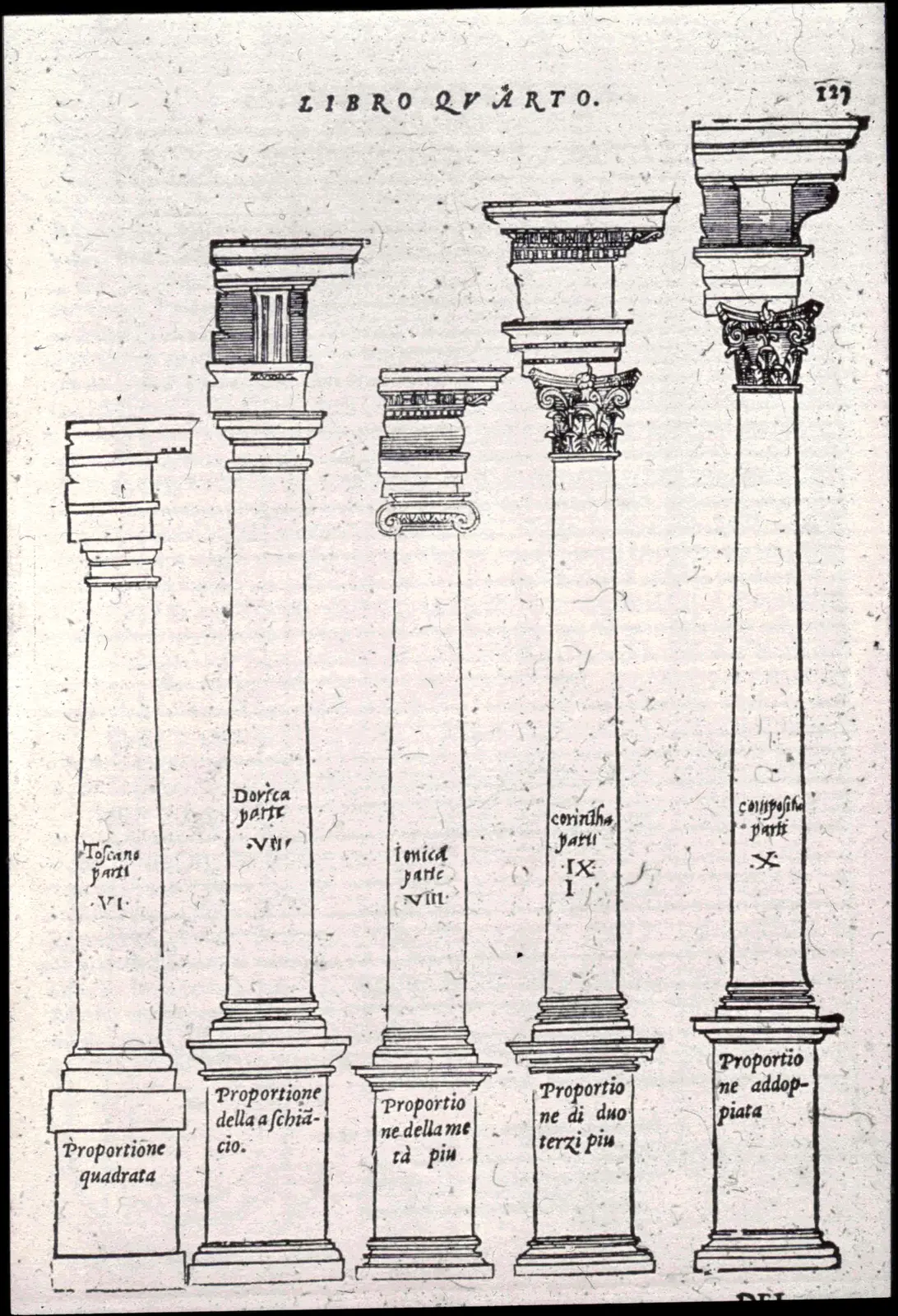
Doric, Ionic, Corinthian: Vitruvius Named Three, Serlio Five
Picture credit
"Ordini architettonici: tuscanico, dorico, ionico, corinzio e composito, from Serlio's fourth book of architecture" by Sebastiano Serlio; slide by Henry A. Millon, Accademia delle Scienze di Torino — https://commons.wikimedia.org/wiki/File:Ordini_architettonici-_tuscanico,_dorico,_ionico,_corinizio_e_composito,_1537_-_Archivio_Accademia_delle_Scienze_Torino,_Millon_66_28_344.jpg — Public Domain (US: published before 1930; EU: author died 1554, more than 70 years ago (life plus 70 years); the scan is a faithful reproduction of a two-dimensional work)
A Comparison
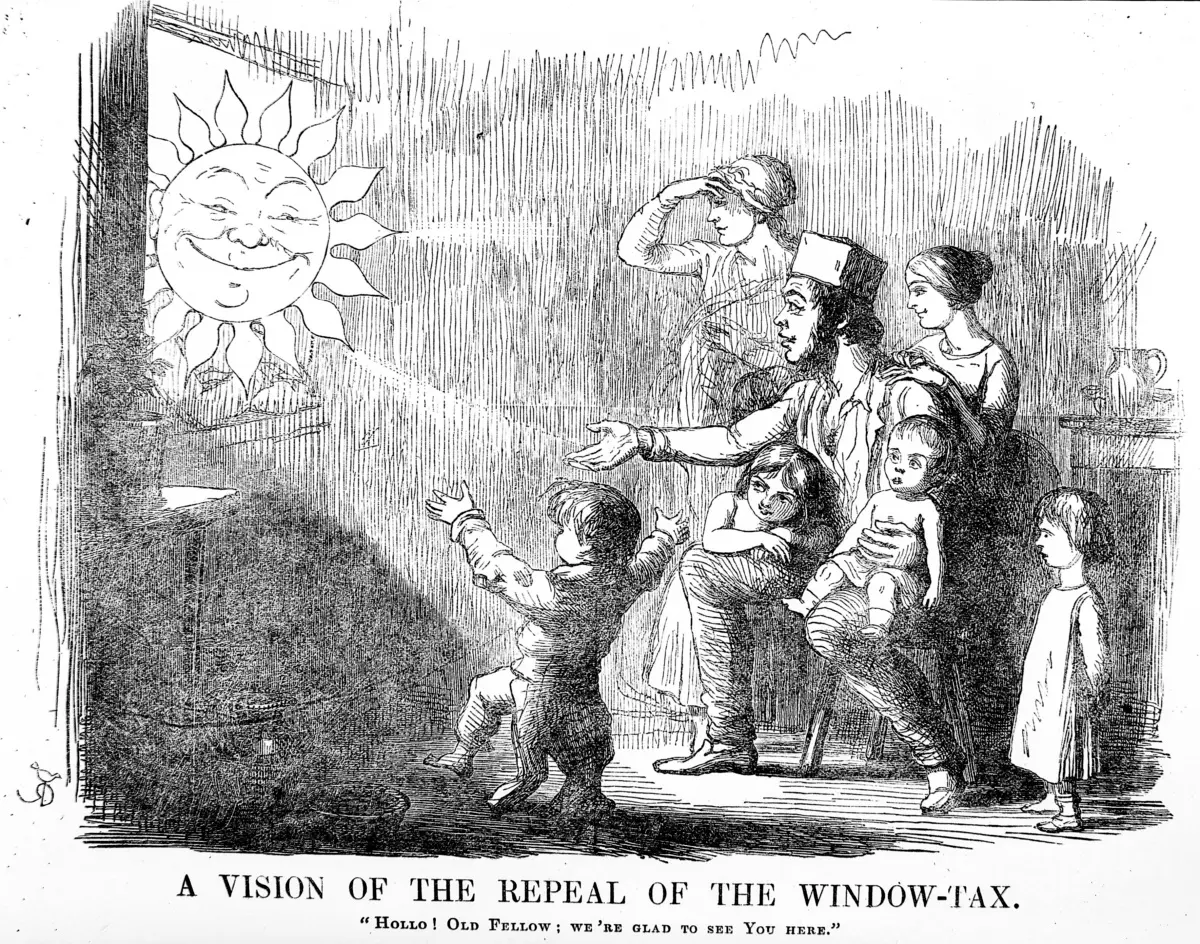
Window Tax: Not Every Blocked-Up Window Was Dodging It
Picture credit
"A Vision of the Repeal of the Window Tax" by Wellcome Library, London. Wellcome Images — https://commons.wikimedia.org/wiki/File:A_Vision_of_the_Repeal_of_the_Window_Tax._Wellcome_M0012506.jpg — CC BY 4.0 (https://creativecommons.org/licenses/by/4.0/); modified: resized to 1,200 px wide
A Comparison
Flemish vs English Bond: Headers Every Row or Every Other
Picture credit
"Bricks - Cambridge, MA - DSC08949" by Daderot — https://commons.wikimedia.org/wiki/File:Bricks_-_Cambridge,_MA_-_DSC08949.jpg — CC0 1.0 (https://creativecommons.org/publicdomain/zero/1.0/); modified: resized to 1,300 px wide