A Comparison
Doric, Ionic, Corinthian: Vitruvius Named Three, Serlio Five
The problem a column had to be “fit to bear a load and also of a satisfactory beauty of appearance,” and builders wanted rules for how tall it stood and how it was dressed.
Built, Mapped & Planted Issued
TL;DR
Doric, Ionic and Corinthian columns are told apart by the capital: a plain rounded cap, a pair of scrolls, or a bell of leaves. Vitruvius wrote of those three orders and, separately, of Tuscan temples. The familiar row of five, with Tuscan and Composite added, is laid out on one plate in Sebastiano Serlio's fourth book of architecture.
| Name | Classical orders: Tuscan, Doric, Ionic, Corinthian and Composite columns |
|---|---|
| Category | Reading a Facade: columns sorted by capital and proportion |
| Where it appears | Columns and porches on temples in Vitruvius; gates, houses and public fronts in Serlio's fourth book |
| Original problem | Making a column fit to bear a load and also of a satisfactory beauty of appearance |
| Sources | Vitruvius, tr. Morgan (1914); Serlio, Book IV, plate of the five orders and the 1611 English edition |
This block as data (CSV) where this data comes from
Data: Vitruvius, The Ten Books on Architecture, tr. M. H. Morgan (1914), Project Gutenberg #20239; Serlio, The Fourth Booke (London: Robert Peake, 1611)
"The five classical orders at one lower diameter" by Built, Mapped & Planted, https://builtmappedandplanted.com/details/classical-orders/ — CC BY 4.0, https://creativecommons.org/licenses/by/4.0/
Data: Heights from the numbers printed on Serlio's plate of the five orders (Book IV); base and capital heights from Vitruvius, The Ten Books on Architecture, tr. M. H. Morgan (1914), Books III–IV, Project Gutenberg #20239, and Serlio, The Fourth Booke (London: Robert Peake, 1611), chapter 9
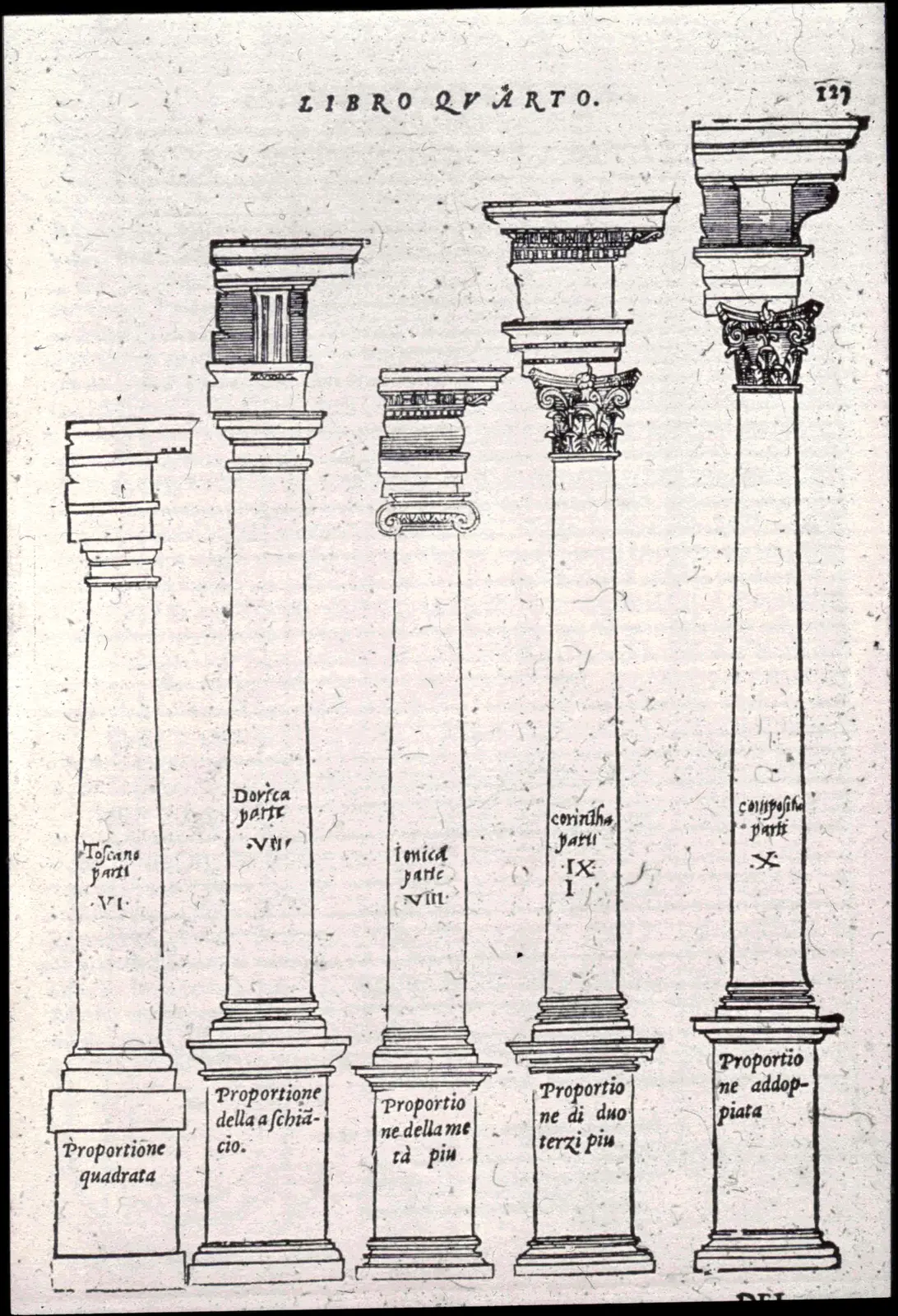
"Ordini architettonici: tuscanico, dorico, ionico, corinzio e composito, from Serlio's fourth book of architecture" by Sebastiano Serlio; slide by Henry A. Millon, Accademia delle Scienze di Torino — https://commons.wikimedia.org/wiki/File:Ordini_architettonici-_tuscanico,_dorico,_ionico,_corinizio_e_composito,_1537_-_Archivio_Accademia_delle_Scienze_Torino,_Millon_66_28_344.jpg — Public Domain (US: published before 1930; EU: author died 1554, more than 70 years ago (life plus 70 years); the scan is a faithful reproduction of a two-dimensional work)
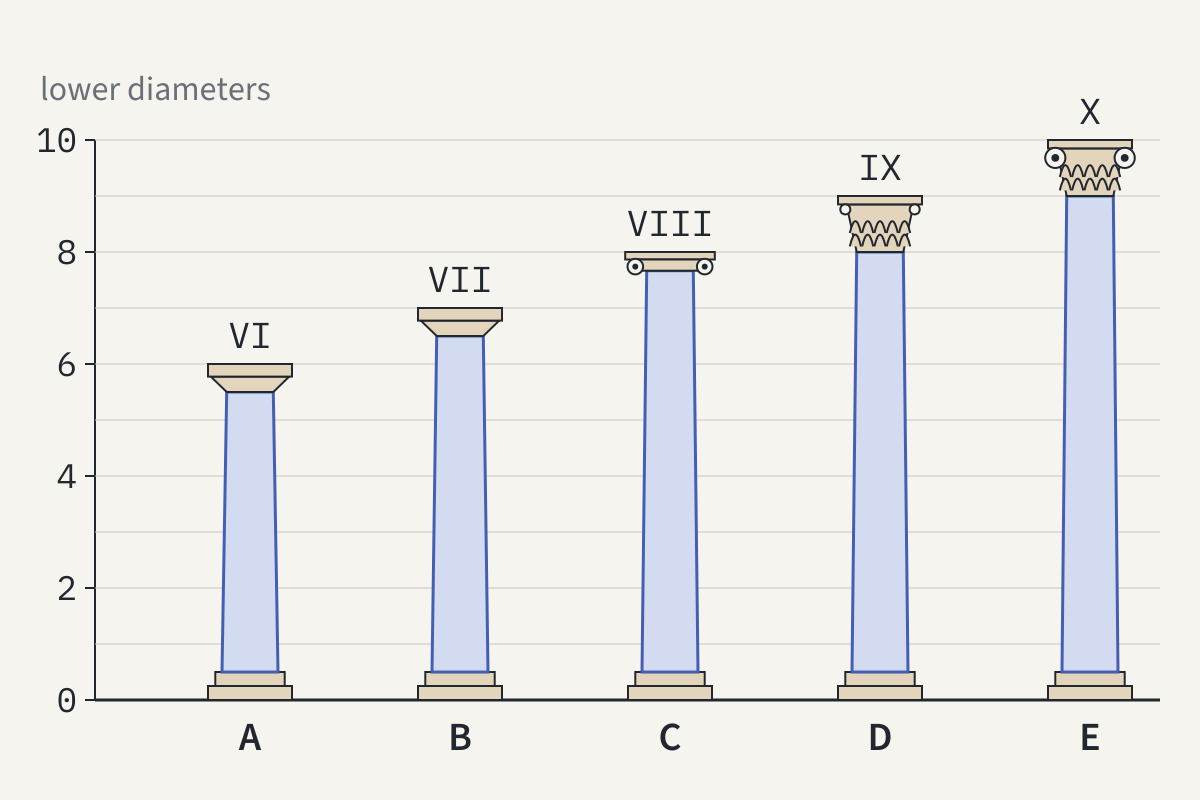
The drawing sets the five orders side by side at one lower diameter, each as tall as its printed number. The picture is Serlio's own plate of the five orders from his fourth book, with the same numbers, VI to X, on the shafts; under the Corinthian's IX stands a further “I” that the plate does not explain.
Basis Heights from the numbers printed on Serlio's plate of the five orders, read as lower diameters; base and capital heights from Vitruvius, Books III and IV (tr. Morgan 1914), and Serlio's Composite chapter; every shaft narrows to five sixths of its lower diameter, the Book III rule for the shortest columns, applied to all five.
Legend: letters and numbers on the drawing
- A Tuscan
- B Doric
- C Ionic
- D Corinthian
- E Composite
- VI height printed on Serlio's plate for the Tuscan, drawn here as 6 lower diameters
- VII height printed for the Doric, drawn as 7
- VIII height printed for the Ionic, drawn as 8
- IX height printed for the Corinthian, drawn as 9
- X height printed for the Composite, drawn as 10
On a bank's front steps, look up at the tops of the columns: scrolls, leaves, or a plain stone cap. That top block is the capital, the carved piece between a column's shaft and the beams it carries. Each of the three choices points to a different order: a named set of rules governing a column's proportions and ornament. The two old books consulted here for those rules, Vitruvius's treatise and Serlio's fourth book, do not agree on how many orders there are.
How do you tell Doric, Ionic and Corinthian apart?
The quickest comparison is at the capital. Vitruvius, in Book IV of his Ten Books on Architecture, gives the Ionic capital volutes, spiral scrolls “hanging down at the right and left like curly ringlets.” He makes the Corinthian capital a full column-width tall, against one third of a width for the Ionic, and explains that the taller capital is what makes a Corinthian column look more slender. Doric is the plain one; in his words it borrowed “manly beauty, naked and unadorned.”
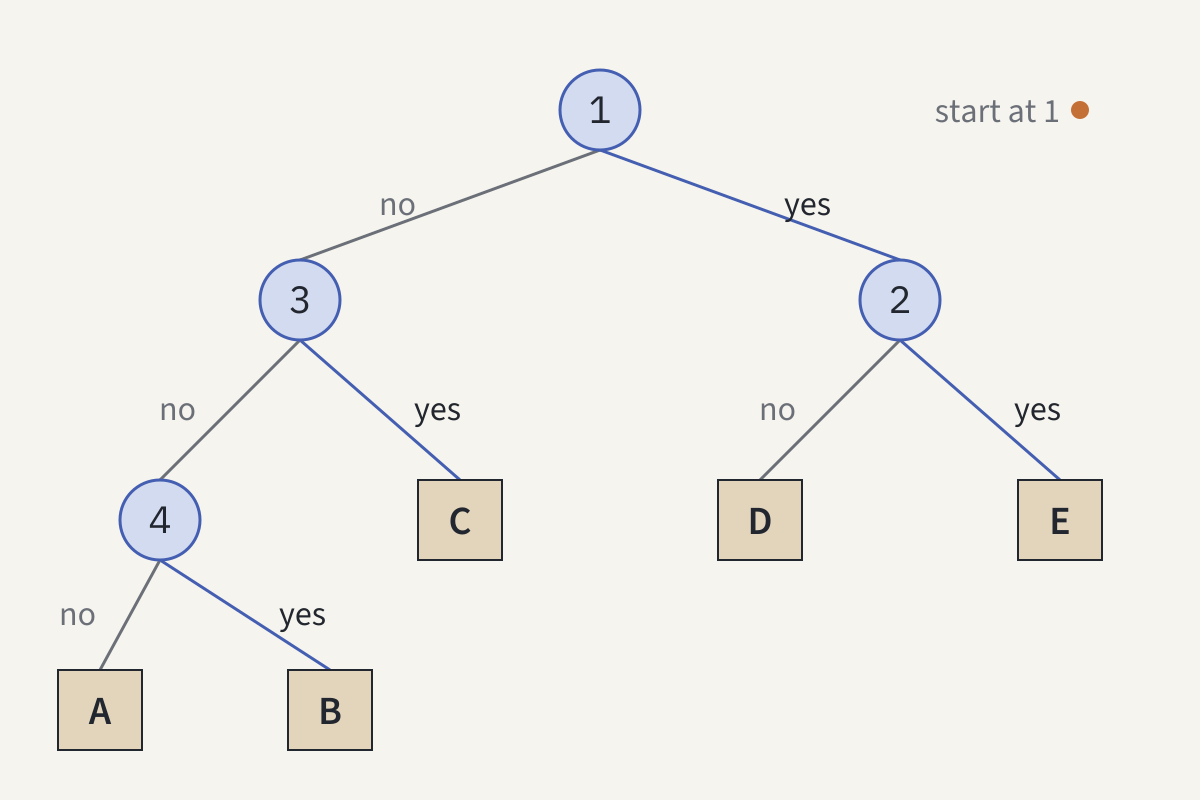
The key asks about the capital first and the frieze last. It follows the two books read here and is a reading aid, not a rule for every building.
Basis Capital and frieze features from Vitruvius, Book IV, chapters 1, 3 and 7 (tr. Morgan 1914), Serlio's Composite chapter (1611 English edition) and the friezes drawn on Serlio's plate.
Legend: letters and numbers on the drawing
- 1 Are there leaves on the capital?
- 2 Is an Ionic capital, scrolls and rounded band, set over the leaves?
- 3 Are there scrolls at the left and right of the capital?
- 4 Does the frieze above carry triglyphs, the blocks cut with vertical grooves?
- A Tuscan
- B Doric
- C Ionic
- D Corinthian
- E Composite
"Key to the classical orders by capital and frieze" by Built, Mapped & Planted, https://builtmappedandplanted.com/details/classical-orders/ — CC BY 4.0, https://creativecommons.org/licenses/by/4.0/
Data: Vitruvius, The Ten Books on Architecture, tr. M. H. Morgan (1914), Book IV, chapters 1, 3 and 7, Project Gutenberg #20239; Serlio, The Fourth Booke (London: Robert Peake, 1611), chapter 9; friezes on Serlio's plate of the five orders
The same key in words:
- Leaves on the capital, with an Ionic capital's scrolls and rounded band set over them: Composite. Serlio describes its capital as the Ionic volute pieced together with the Corinthian capital.
- Leaves on the capital, with smaller scrolls growing out from among them: Corinthian. Vitruvius has these volutes rise on stalks between the leaves and run out to the corners of the abacus, the slab on top. On Serlio's plate the two capitals look much alike.
- No leaves, scrolls at the left and right: Ionic.
- No leaves or scrolls, and triglyphs in the frieze: Doric. Vitruvius places the triglyphs over the centers of the columns in his Doric temples.
- No leaves or scrolls, and a plain frieze: Tuscan. On Serlio's plate the Tuscan frieze is bare, while the Doric one carries a triglyph.
Where does the Corinthian capital come from? Vitruvius presents the answer as a story that “is related,” not as a documented event. In his account, a nurse left a basket of a dead girl's possessions on her tomb in Corinth and covered it with a roof tile. In the story, an acanthus plant grew up around the basket, and the tile pressed on its stalks and bent them into volutes at the corners.
Vitruvius then has Callimachus, an artist the Athenians praised for refined work, pass the tomb and admire the leaves around the basket. According to Vitruvius, Callimachus “built some columns after that pattern for the Corinthians” and set the rules for the proportions that followed.
How tall is each order?
Heights in Vitruvius are measured against the thickness of the column at its foot, its lower diameter. He gives two sets of figures for the Doric and Ionic. In his founding story, the original Doric column was six times as tall as its thickness, scaled from the length of a man's foot against his height, and the original Ionic was eight.
Later generations, he writes, “established seven diameters of the thickness as the height of the Doric column, and nine as that of the Ionic.” For Tuscan temples he sets the thickness of a column at one seventh of its height. Vitruvius gives the Corinthian no height of its own, describing its columns as “of the same proportions in all respects as Ionic” apart from the taller capital, so the chart and table give it no row and the data file leaves that cell empty.
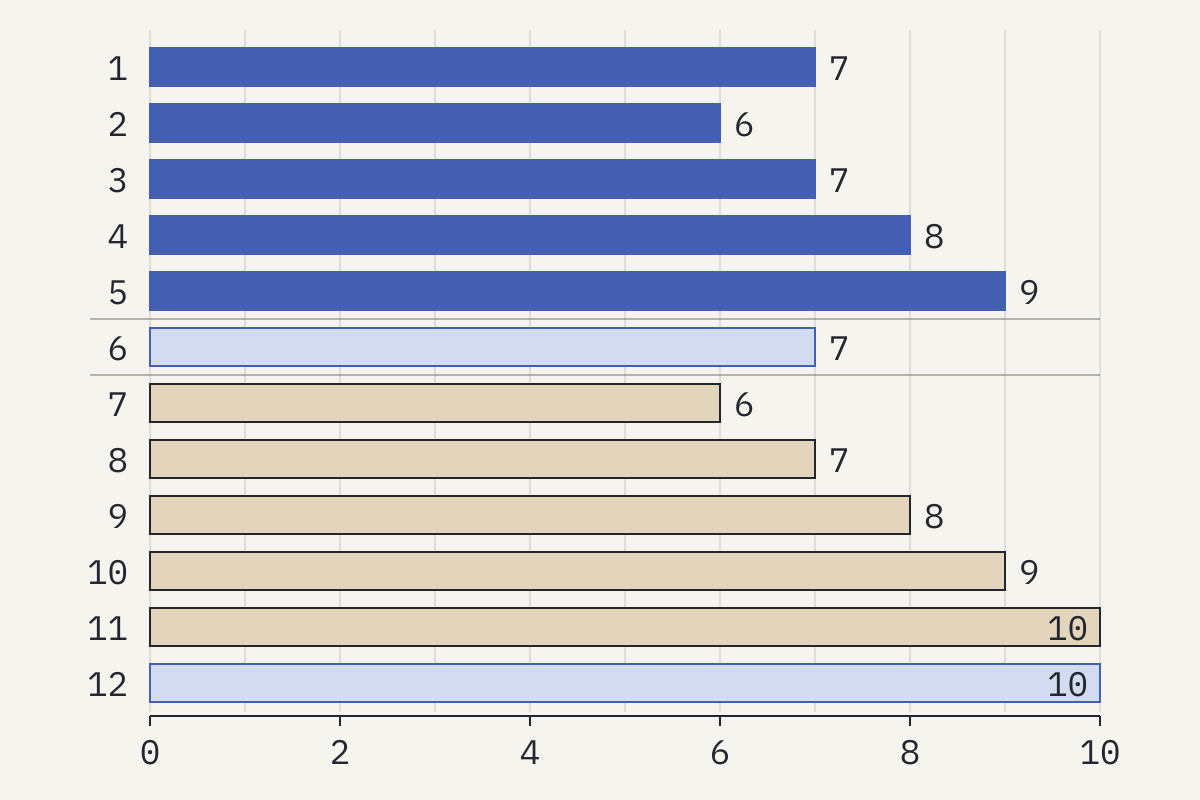
Each bar is one statement in one book, and the rows are kept apart rather than averaged. Rows 7 to 11 are the numbers written on Serlio's plate.
Basis Heights transcribed from Vitruvius (tr. Morgan 1914) and Serlio (the plate and the 1611 English edition); each bar matches one row of the table below.
Legend: letters and numbers on the drawing
- 1 Vitruvius, Tuscan
- 2 Vitruvius, Doric, the founding Doric column in his story
- 3 Vitruvius, Doric, later practice
- 4 Vitruvius, Ionic, the founding Ionic column in his story
- 5 Vitruvius, Ionic, later practice
- 6 Serlio's text on the Tuscan, quoting Vitruvius
- 7 Serlio's plate, Tuscan
- 8 Serlio's plate, Doric
- 9 Serlio's plate, Ionic
- 10 Serlio's plate, Corinthian
- 11 Serlio's plate, Composite
- 12 Serlio's text on the Composite
"Column heights of the orders, by source" by Built, Mapped & Planted, https://builtmappedandplanted.com/details/classical-orders/ — CC BY 4.0, https://creativecommons.org/licenses/by/4.0/
Data: Vitruvius, The Ten Books on Architecture, tr. M. H. Morgan (1914), Project Gutenberg #20239; Serlio, The Fourth Booke (London: Robert Peake, 1611); Serlio's plate of the five orders
| Row | Order | Source | Height | Unit | Note |
|---|---|---|---|---|---|
| 1 | Tuscan | Vitruvius, Book IV, ch. 7 | 7 | lower diameters | thickness one seventh of the height |
| 2 | Doric | Vitruvius, Book IV, ch. 1 | 6 | lower diameters | founding Doric column in his story |
| 3 | Doric | Vitruvius, Book IV, ch. 1 | 7 | lower diameters | later practice |
| 4 | Ionic | Vitruvius, Book IV, ch. 1 | 8 | lower diameters | founding Ionic column in his story |
| 5 | Ionic | Vitruvius, Book IV, ch. 1 | 9 | lower diameters | later practice |
| 6 | Tuscan | Serlio, Book IV, ch. 5 | 7 | lower diameters | quoting Vitruvius, with base and capital |
| 7 | Tuscan | Serlio's plate | 6 | not named on the plate | printed VI |
| 8 | Doric | Serlio's plate | 7 | not named on the plate | printed VII |
| 9 | Ionic | Serlio's plate | 8 | not named on the plate | printed VIII |
| 10 | Corinthian | Serlio's plate | 9 | not named on the plate | printed IX |
| 11 | Composite | Serlio's plate | 10 | not named on the plate | printed X |
| 12 | Composite | Serlio, Book IV, ch. 9 | 10 | “parts,” not defined | with base and capital |
Download the column heights by source (CSV) (where this data comes from) Data: Vitruvius, The Ten Books on Architecture, tr. M. H. Morgan (1914), Project Gutenberg #20239, read 2026-11-18; Serlio, The Fourth Booke, in The Five Books of Architecture (London: Robert Peake, 1611), Internet Archive firstbookeofarch00serl, pages read 2026-11-18; Serlio's plate of the five orders, Accademia delle Scienze di Torino scan via Wikimedia Commons
Serlio's plate writes a number on each shaft, from VI for the Tuscan to X for the Composite. It does not say what is being counted. His Composite chapter agrees with the plate: the column, “with Base and Capitall,” is 10 parts, and its base is half the column's thickness.
His Tuscan chapter names the unit, a measure “taken from the thicknesse of the Columne below,” but it opens by quoting the seven parts of Vitruvius, while the plate prints VI. The two figures are kept as printed, side by side, rather than reconciled.
The plate also stands each column on a pedestal, and Serlio's preface gives those pedestals a rising series of shapes. The Tuscan pedestal is “a perfect fouresquare,” the Doric is as tall as the diagonal of that square, the Ionic is a square and a half, the Corinthian a square and two thirds, and the Composite two squares. The Italian plate prints the same series on the pedestal faces, from “Proportione quadrata” to “Proportione addoppiata.”
Where the five-order lineup comes from
Why five and not three? The 1914 translation heads chapter 1 of Book IV “The Origins of the Three Orders,” and Vitruvius's text names “the three orders, Doric, Ionic, and Corinthian.” He describes Tuscan temples in a separate chapter, after setting out the laws for the other three. Other capitals existed in his day, he adds, but “nor can we recognize from them another order of columns.”
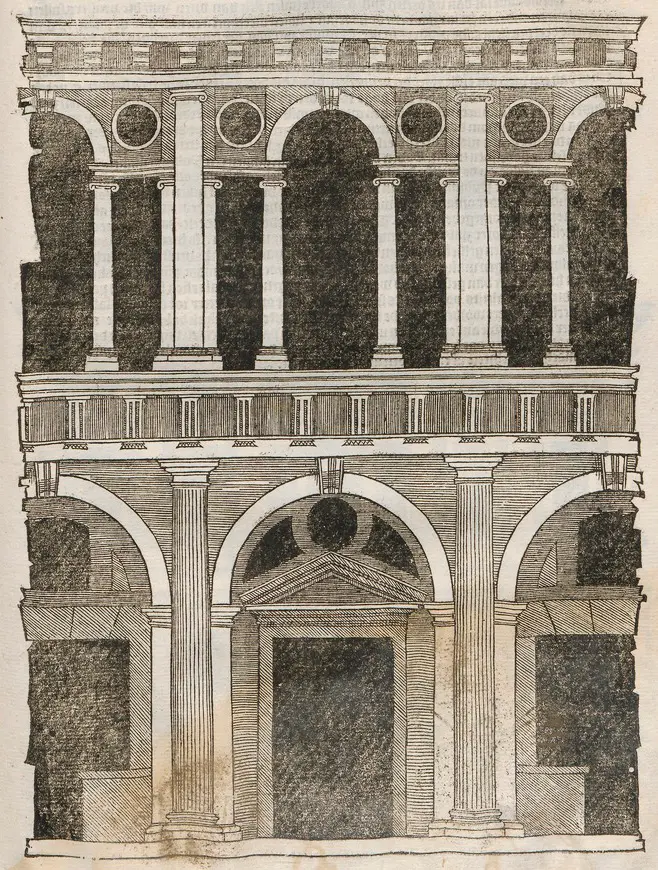
A facade from Serlio's fourth book, folio XXIX in the copy scanned: columns under a frieze of triglyphs on the lower story and smaller scroll-capital columns on the upper one.
"Facade design, from Serlio's fourth book of architecture, folio XXIX" by Sebastiano Serlio; Utrecht University Library copy — https://commons.wikimedia.org/wiki/File:Sebastiano_Serlio_Livro_IV_Fol_XXIX.jpg — Public Domain (US: published before 1930; EU: author died 1554, more than 70 years ago (life plus 70 years); the scan is a faithful reproduction of a two-dimensional work)
Serlio counted differently. His chapter on the Composite, in the English edition printed for Robert Peake in 1611, opens with this sentence: “Although Vitruvius speaketh of foure maner of Columnes, as Dorica, Ionica, Corinthia and Thuscana, giuing hereby vnto vs almost the first and simple maner of ornaments of Architecture: neuerthelesse, I haue added one to the sayd foure, as (almost) a fift maner of Pillar, composed of the others aforesayd, moued thereunto by the authoritie of Romane worke, which we may see with our eyes.”
By his count, Vitruvius had four orders, and Serlio took the fifth from Roman buildings, then placed all five on a single page near the front of the book. In his preface he compares the page to the prologue of a comedy, explaining that “in the beginning thereof, men should see the Figures of all the seueral kinds whereof I purpose to entreat of.” An Italian printing of that plate appears at the top of this page; the Turin academy's scan of it is dated 1537 in its record.
The same book matches the orders to kinds of buildings. Serlio judged the Tuscan, as the roughest, “fit for strengths, for Gates of Cities, Townes and Castles,” and treasuries, armories, prisons and harbors. Doric, in his scheme, suited churches of saints he counted as soldiers of the faith, and houses built for “men of armes, and strong personages.”
His pages then put the orders to work on gates and house fronts. For one city gate in his Tuscan chapter (fol. 6 of the 1611 edition), he notes that the column “is a third part set into the wall, and is bound fast with other stones, more for shew then bearing.” A column partly sunk into a wall is another feature a façade can fake.
Greek and Roman Doric on the street
What is the difference between Greek and Roman Doric? The two books read here do not sort Doric by those labels; the difference they do discuss is the base, the ring of moldings at the foot of a column. Vitruvius describes the Ionic as the column on which builders “substituted the base in place of a shoe.” His rules for Doric temples give the column's thickness, height and capital, but no base.
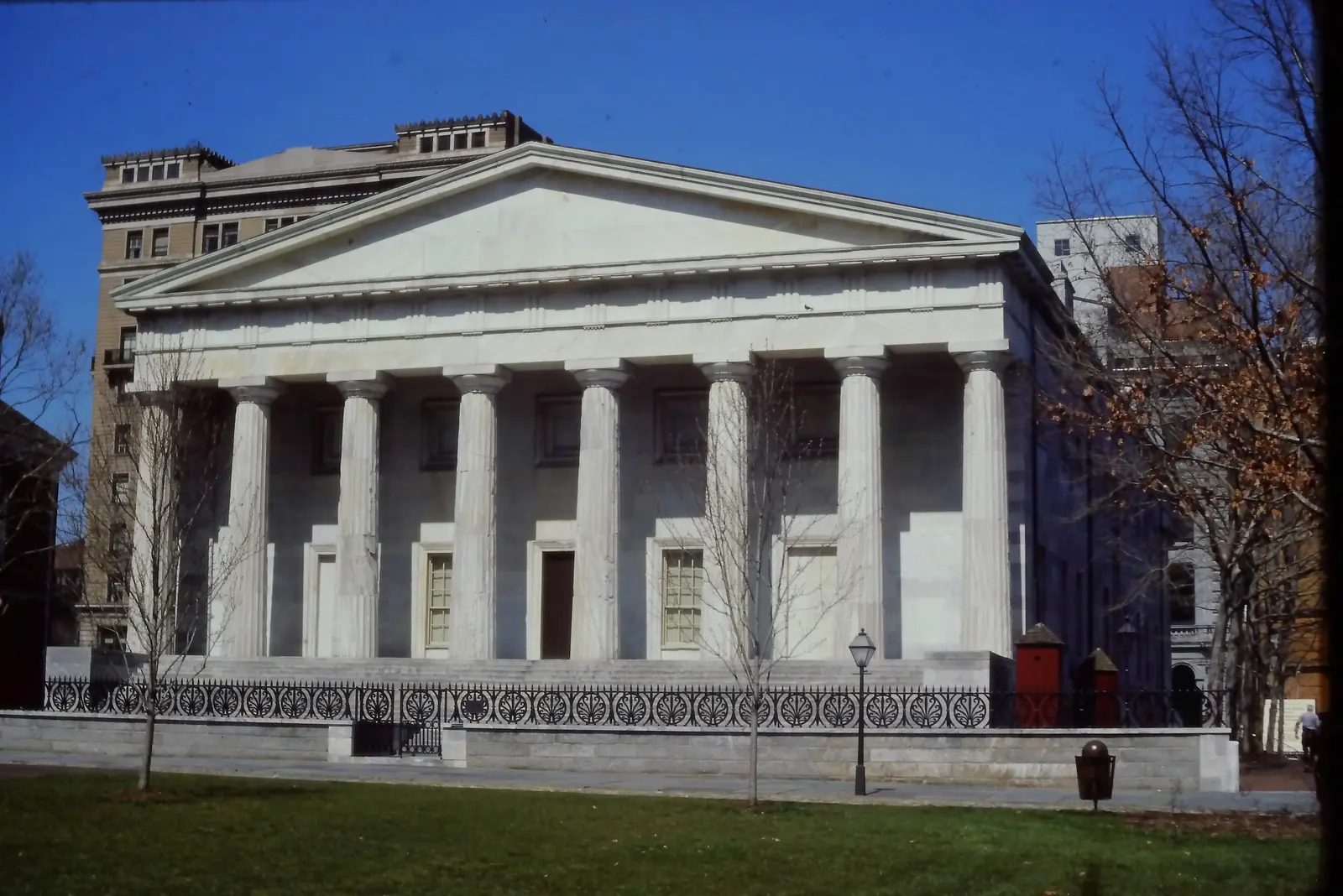
A columned front of the Second Bank of the United States in Philadelphia, photographed in 1984. Its fluted Doric shafts run straight down to the top step, with no base between.
"Greek Revival - Philadelphia, PA - Second Bank of the United States (1)" by Bmzuckerman — https://commons.wikimedia.org/wiki/File:Greek_Revival_-_Philadelphia,_PA_-_Second_Bank_of_the_United_States_(1).jpg — CC BY 4.0 (https://creativecommons.org/licenses/by/4.0/)
Serlio recorded the baseless kind, and every example he named lay in Italy. “And some also thinke,” he writes, “that Dorica Columnes had no Bases,” citing the Theater of Marcellus, where the columns rest “vpon a step, without any other support.” He adds a Doric temple at the Carcer Tulliano in Rome and a triumphal arch in Verona.
He still gave his own Doric a base: “I affirme, that the Bases Atticurga, which Vitruvius, in his third Booke, so nameth, are the Dorica Bases.” He points to Bramante's buildings in Rome as his authority, and his plate shows the Doric standing on that base.
So Doric can be built either way, and these sources do not divide the two forms along a clean Greek and Roman line. The bank in the photograph is filed on its photo record as Greek Revival, built 1819–24 to a design by William Strickland, and its columns follow the baseless form. The wall behind a columned porch can be read too, and Flemish bond reads a brick wall brick by brick.
Cite this page
Built, Mapped & Planted. “Doric, Ionic, Corinthian: Vitruvius Named Three, Serlio Five.” First issued 19 November 2026. https://builtmappedandplanted.com/details/classical-orders/. Accessed on the day you read it.
Sources
- Vitruvius, The Ten Books on Architecture, translated by Morris Hicky Morgan (Cambridge, MA: Harvard University Press, 1914). Project Gutenberg eBook #20239. www.gutenberg.org/ebooks/20239Read: full text; the 1914 preface, Book II, chapters 4, 5, 6 and 8 (sections 1–3), Book III, chapter 5, Book IV, introduction and chapters 1, 3, 7 and 8, and Book V, chapter 12 read closely
- Sebastiano Serlio, The First [-Fift] Booke of Architecture, translated out of Italian into Dutch and out of Dutch into English (London: Robert Peake, 1611). archive.org/details/firstbookeofarch00serlRead: Book III, chapter 4: first page, second page, fol. 2 verso and fol. 3 read against the page images; Book IV: Author to the Reader, plate of the five orders (fol. 3), opening pages of chapters 5, 6 and 9, and the city-gate page of chapter 5 read against the page images
- Sebastiano Serlio, Ordini architettonici: tuscanico, dorico, ionico, corinzio e composito, plate from the fourth book of architecture; slide by Henry A. Millon, Accademia delle Scienze di Torino, Fondo Millon 66_28_344 (Wikimedia Commons file record, dated 1537). commons.wikimedia.org/wiki/File:Ordini_architettonici-_…Read: file page and full image

How numbers and sources are checkedRedline sheet: all correctionsReport an error on this page (contact@builtmappedandplanted.com)
More sheets in Reading a Facade
A Field sheet entry
Gargoyle vs Grotesque: Strictly, a Gargoyle Is a Waterspout
Picture credit
"Etchings of Paris: The Gargoyle (Le Stryge), by Charles Meryon" by Charles Meryon — https://commons.wikimedia.org/wiki/File:Charles_Meryon_-_Etchings_of_Paris-_The_Gargoyle_-_1940.889_-_Cleveland_Museum_of_Art.jpg — CC0 1.0 (https://creativecommons.org/publicdomain/zero/1.0/)
A Comparison
Window Tax: Not Every Blocked-Up Window Was Dodging It
Picture credit
"A Vision of the Repeal of the Window Tax" by Wellcome Library, London. Wellcome Images — https://commons.wikimedia.org/wiki/File:A_Vision_of_the_Repeal_of_the_Window_Tax._Wellcome_M0012506.jpg — CC BY 4.0 (https://creativecommons.org/licenses/by/4.0/); modified: resized to 1,200 px wide
A Comparison
Flemish vs English Bond: Headers Every Row or Every Other
Picture credit
"Bricks - Cambridge, MA - DSC08949" by Daderot — https://commons.wikimedia.org/wiki/File:Bricks_-_Cambridge,_MA_-_DSC08949.jpg — CC0 1.0 (https://creativecommons.org/publicdomain/zero/1.0/); modified: resized to 1,300 px wide