A Comparison
Flemish vs English Bond: Headers Every Row or Every Other
The problem a brick wall two layers thick behaves as two thin walls unless something ties the front layer to the one behind it, and in a bonded wall that tie is a brick reaching back across both.
Built, Mapped & Planted Issued
TL;DR
In a solid brick wall, whole headers (bricks laid across the wall) show their short ends on the face and reach back to tie the front layer to the layer behind. English bond puts a whole course of headers in every other course. Flemish bond alternates header and stretcher along every course.
| Name | Flemish bond and English bond (patterns for laying brick) |
|---|---|
| Category | Reading a Facade |
| Where it appears | Old brick walls laid in courses, such as a wall in Cambridge, Massachusetts and a curved wall in Twickenham, London |
| Original problem | Keep a brick wall two or more layers thick from splitting into separate thin walls |
| Key dimensions or parameters | Headers about two thirds of the bricks in English bond and about half in Flemish bond, by count (model) |
| Sources | Rivingtons, Notes on Building Construction, Part I (1883); Commons file pages |
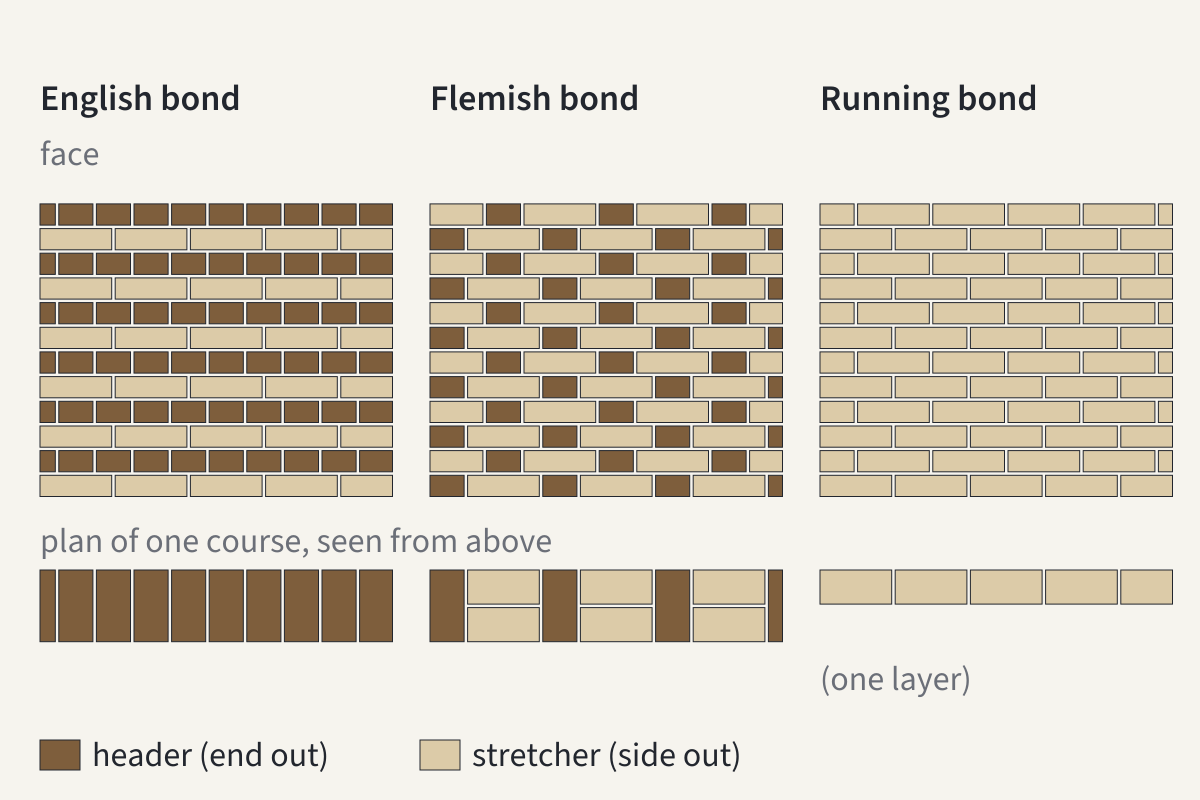
"English, Flemish and running bond, face and plan" by Built, Mapped & Planted, https://builtmappedandplanted.com/details/flemish-bond/ — CC BY 4.0, https://creativecommons.org/licenses/by/4.0/
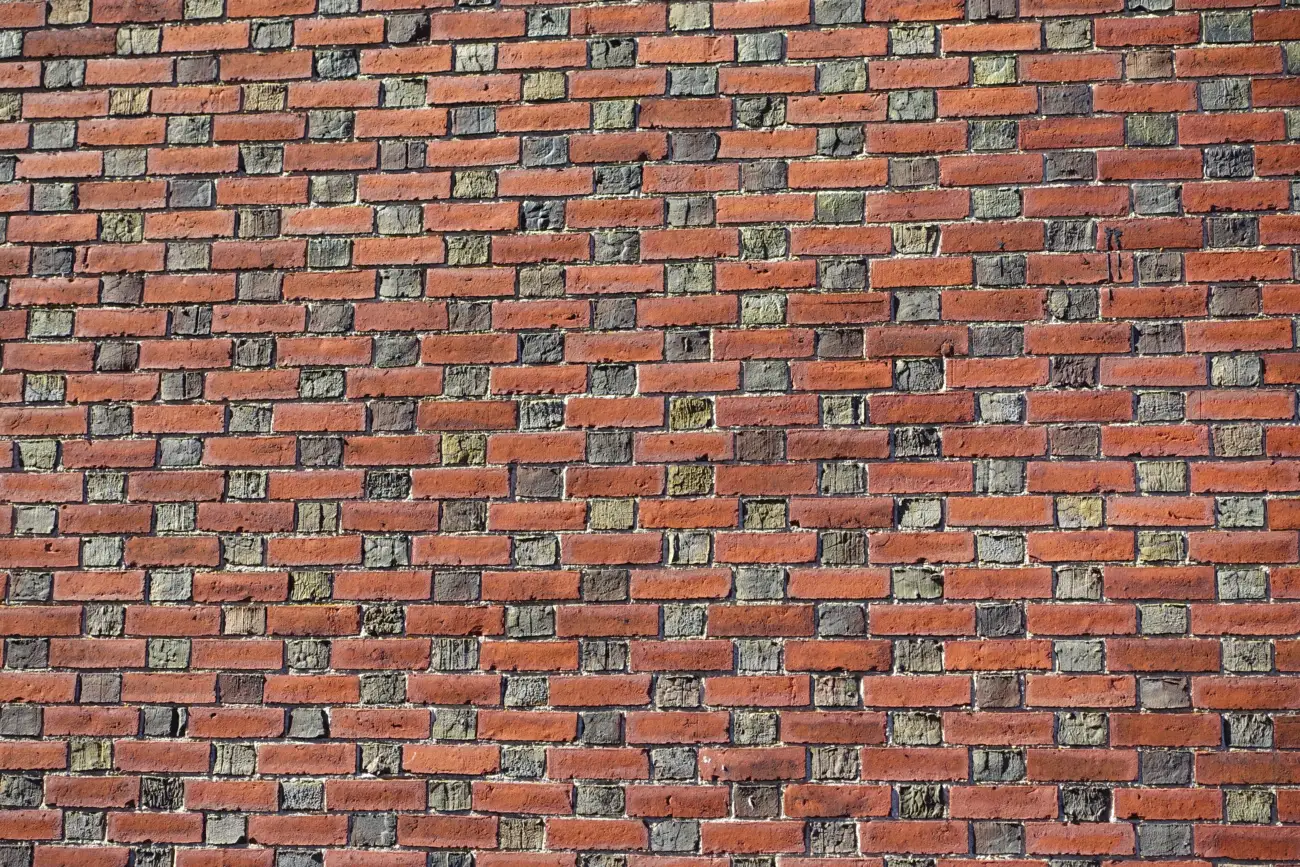
"Bricks - Cambridge, MA - DSC08949" by Daderot — https://commons.wikimedia.org/wiki/File:Bricks_-_Cambridge,_MA_-_DSC08949.jpg — CC0 1.0 (https://creativecommons.org/publicdomain/zero/1.0/); modified: resized to 1,300 px wide
The drawing sets twelve courses of English, Flemish and running bond side by side, with a plan of one course of each; the picture is a brick wall in Cambridge, Massachusetts, where darker short ends alternate with red long faces along each course.
Basis Pattern rules from Notes on Building Construction, Part I (1883), pages 15 and 20, drawn with modular bricks 7 5/8 by 2 1/4 inches on the face and 3/8-inch joints; the running-bond half-brick shift is drawn for this page.
Run your eye along one row of an old brick wall: long face, short end, long face. That repeating rhythm, kept up in every course, is the signature of Flemish bond. The long faces belong to stretchers, which are bricks laid lengthwise along the wall, and the short ends belong to headers. Notes on Building Construction, a builders' manual published by Rivingtons in 1883, defines headers as “bricks whose lengths lie across the thickness of the wall” (Part I, p. 13).
Why are some bricks turned endways? A brick laid along the wall stays inside a single layer of brickwork, while a brick laid across the wall reaches into the layer behind it. The same page of the manual warns that “a wall may appear on the face to be well bonded, when in fact there is no bond at all between its front and back” (1883, p. 13).
A bond, in this sense, is the rule that decides which bricks are turned endways and where. That rule in turn decides how the separate layers of a solid wall are tied together.
How many headers does each bond use?
The two bonds place their headers differently. In the manual's words, English bond “shows both on face and back, stretching and heading courses alternately” (1883, p. 15), so each course of long faces sits on a course of short ends. Flemish bond shows “in every course, headers and stretchers alternately” (1883, p. 20), and the manual places each header directly over the middle of a stretcher in the course below.
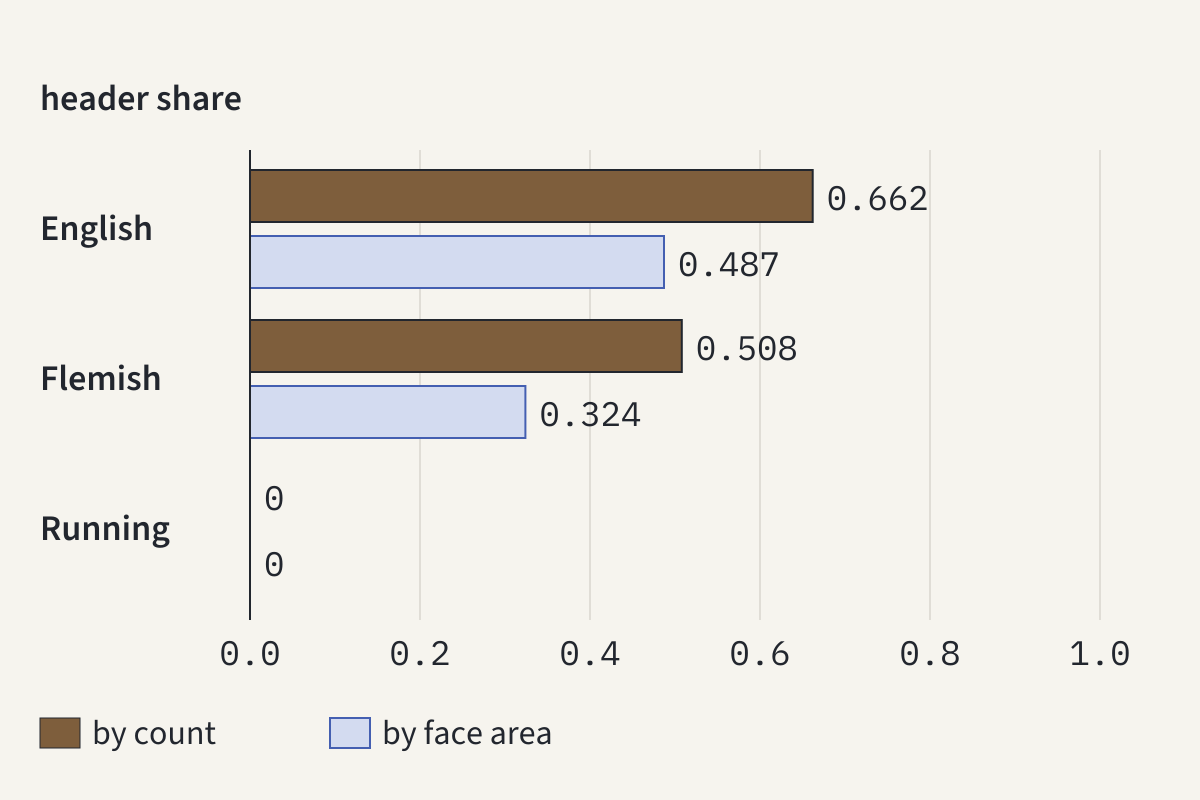
Headers as a share of the bricks in each bond, and as a share of the brick surface on the face, mortar joints left out, counted from a drawn layout of modular bricks. Running bond has no headers at all.
Basis Shares counted from a drawn layout of 40 courses, 200 inches long, with modular bricks 7 5/8 by 2 1/4 inches on the face and 3/8-inch joints; the counts match the exact fractions for each bond within 0.01.
"How many headers each brick bond uses" by Built, Mapped & Planted, https://builtmappedandplanted.com/details/flemish-bond/ — CC BY 4.0, https://creativecommons.org/licenses/by/4.0/
Counted brick by brick, headers make up about two thirds of the bricks in an English bond face (0.662 by count in this layout) and about half of those in a Flemish bond face (0.508 by count). English bond contains more of them because a course of headers holds about twice as many bricks as a course of stretchers of the same length.
Measured by face area, the shares are smaller: 0.487 of the brick surface in an English bond face and 0.324 in a Flemish face, mortar joints left out, because the end of a brick exposes less than half as much surface as its side.
| Bond | Pattern rule | Headers by count | Headers by face area | Ties two layers |
|---|---|---|---|---|
| English | courses alternate: all stretchers, then all headers | 0.662 | 0.487 | yes, in a solid wall |
| Flemish | every course alternates header and stretcher | 0.508 | 0.324 | yes, in a solid wall |
| Running | stretchers only, each course offset half a brick | 0 | 0 | no |
Download the header shares (CSV) (where this data comes from)
Both bonds also need a few cut pieces near the corners. The manual explains that closers are “pieces of brick inserted in alternate courses, in order to prevent two headers from being exactly over each stretcher, and thus to obtain a lap” (1883, p. 13), and it places them in Flemish bond “next to the corner headers to give the lap” (1883, p. 20).
Without closers, the manual shows, every other vertical joint would run straight through the whole depth of the wall, dividing it into “several independent vertical strips or piers” (1883, p. 13).
Running bond, which the manual calls stretching bond, has no headers to count at all. In a wall thicker than one layer, the manual observes that “There is no transverse tie” (1883, p. 15), so the block of brickwork separates into independent thin walls standing side by side. The numbers in the table come from a drawn layout, not from measuring any real wall.
Solid wall or veneer?
A brick veneer is a single layer of brick set in front of a backing made of some other material. Because a veneer has no second layer of brick for a header to reach into, a short end visible in its face can be a cut half-brick that ties nothing. Laid in a pattern, such half-bricks make the face resemble Flemish or English bond.
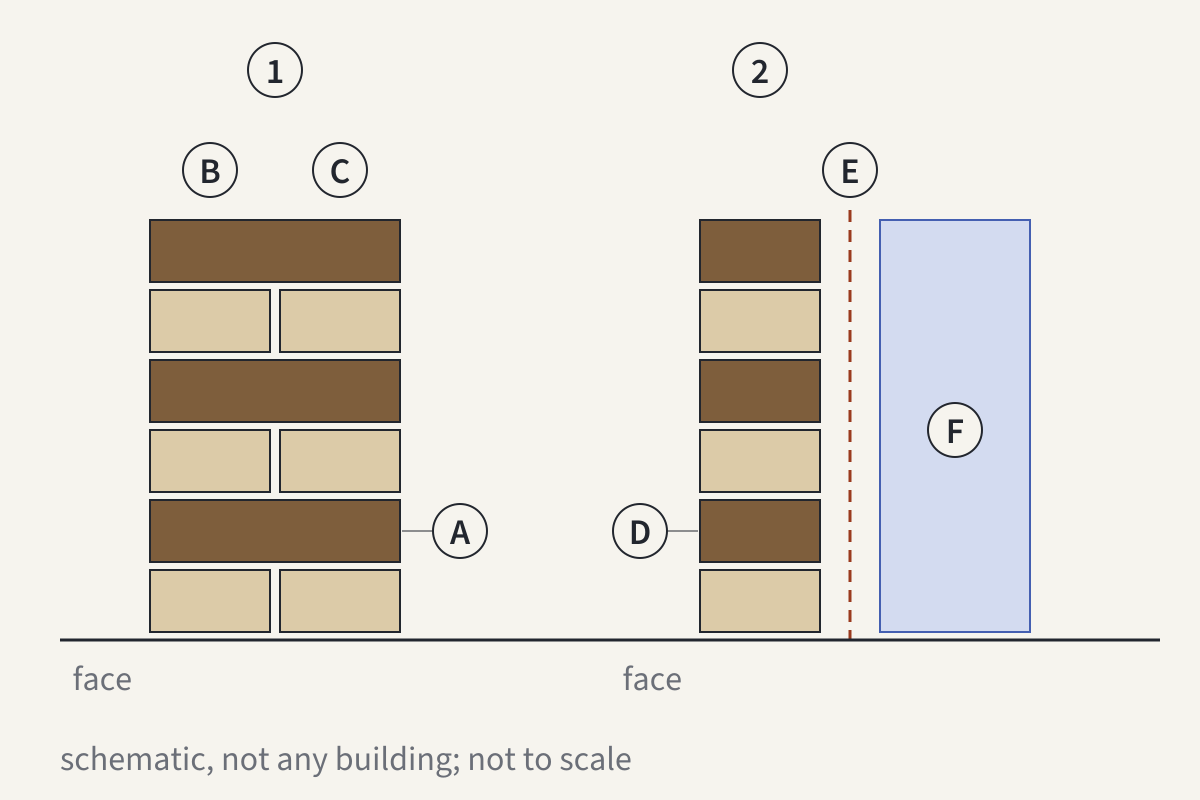
Two schematic sections cut through the thickness of a wall, not any real building: in the first, whole headers cross both layers of brick; in the second, a half-brick looks like a header from the street but stops at the face.
Basis Header and false-header definitions from Notes on Building Construction, Part I (1883), pages 13 and 22; the veneer section is drawn for this page; no dimensions, not to scale.
Legend: letters and numbers on the drawing
- 1 a solid wall of two brick layers
- 2 a brick veneer in front of a backing
- A a whole header crossing both layers
- B the front layer of brick
- C the back layer of brick
- D a half-brick that shows an end in the face but stops at the face layer
- E a joint that runs straight up behind the face
- F a backing of another material
"Solid wall and brick veneer, sections (schematic)" by Built, Mapped & Planted, https://builtmappedandplanted.com/details/flemish-bond/ — CC BY 4.0, https://creativecommons.org/licenses/by/4.0/
Half-bricks disguised as headers are not a recent invention. The 1883 manual describes walls built in “Double Flemish bond with false headers,” in which a 14-inch wall shows headers that “consist only of half-bricks, having no bond with the interior of the wall” (1883, p. 22). It adds that “This arrangement is often adopted when the facing is of superior bricks,” and that “The half-bricks look like headers, though they are useless for the bond” (1883, p. 22).
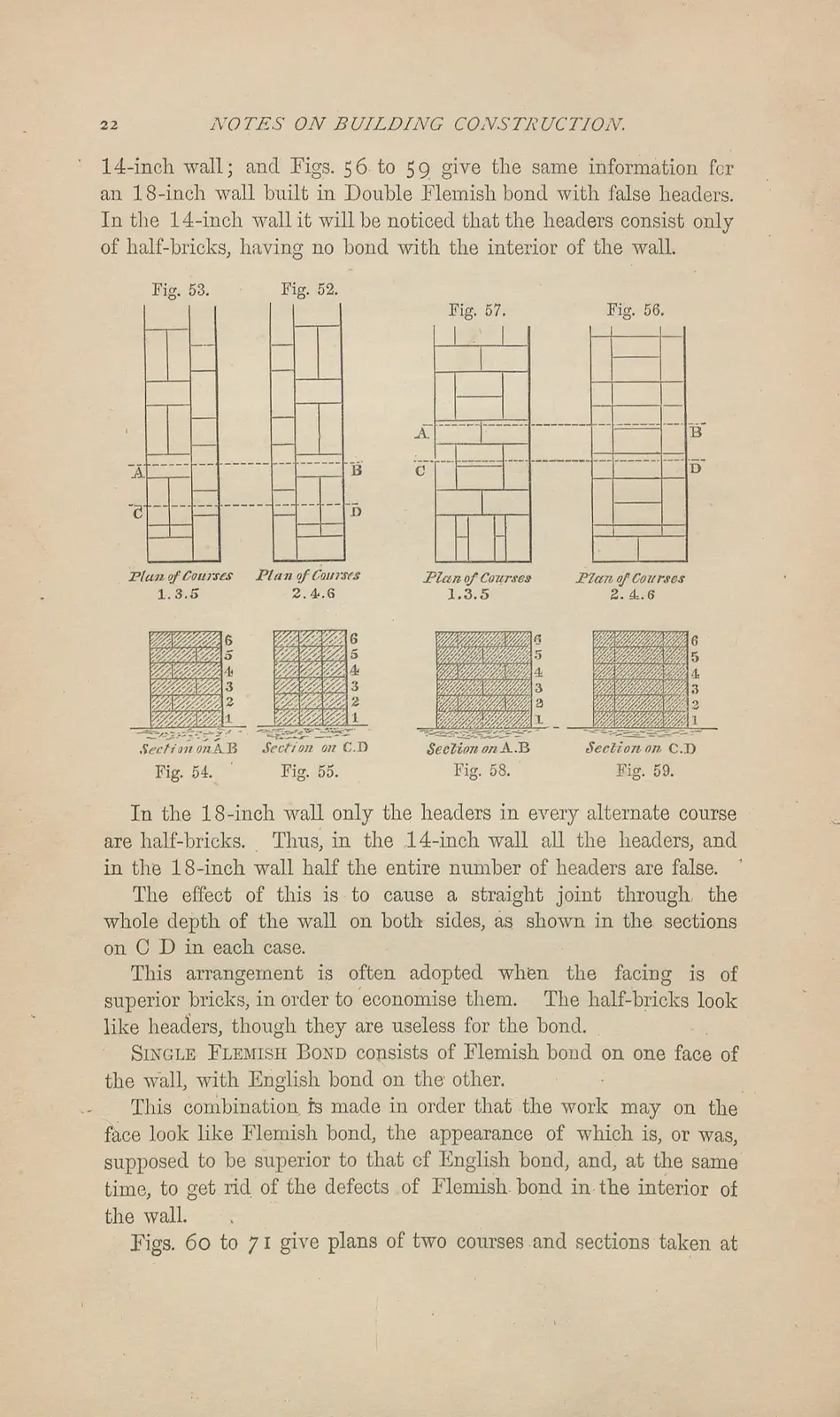
Page 22 of Rivingtons' Notes on Building Construction, Part I (1883), with plans and sections of 14-inch and 18-inch walls in double Flemish bond with false headers.
"Double Flemish bond with false headers, page 22, from Notes on Building Construction, Part I (1883)" by Unknown author (Notes on Building Construction, Part I, Rivingtons, 1883) — https://archive.org/details/RivingtonsPart12ndEd1883/page/n41/mode/1up — Public Domain (US: published 1883; EU: anonymous work published 1883, more than 70 years ago (70 years from publication); Internet Archive item marked Public Domain Mark 1.0)
How can you tell a solid wall from a veneer? From the street, the face alone cannot settle the question, since a half-brick and a whole header show the same end. A face made only of long sides shows no brick reaching back at all, and whatever connects it to the construction behind remains out of sight. Whether a particular wall is solid, and how it stands, is a question for the local building authority or a licensed structural engineer.
English bond on a real wall
A curved brick wall in Twickenham, London, shows the English pattern clearly. Its courses alternate: long faces in one, short ends in the next.
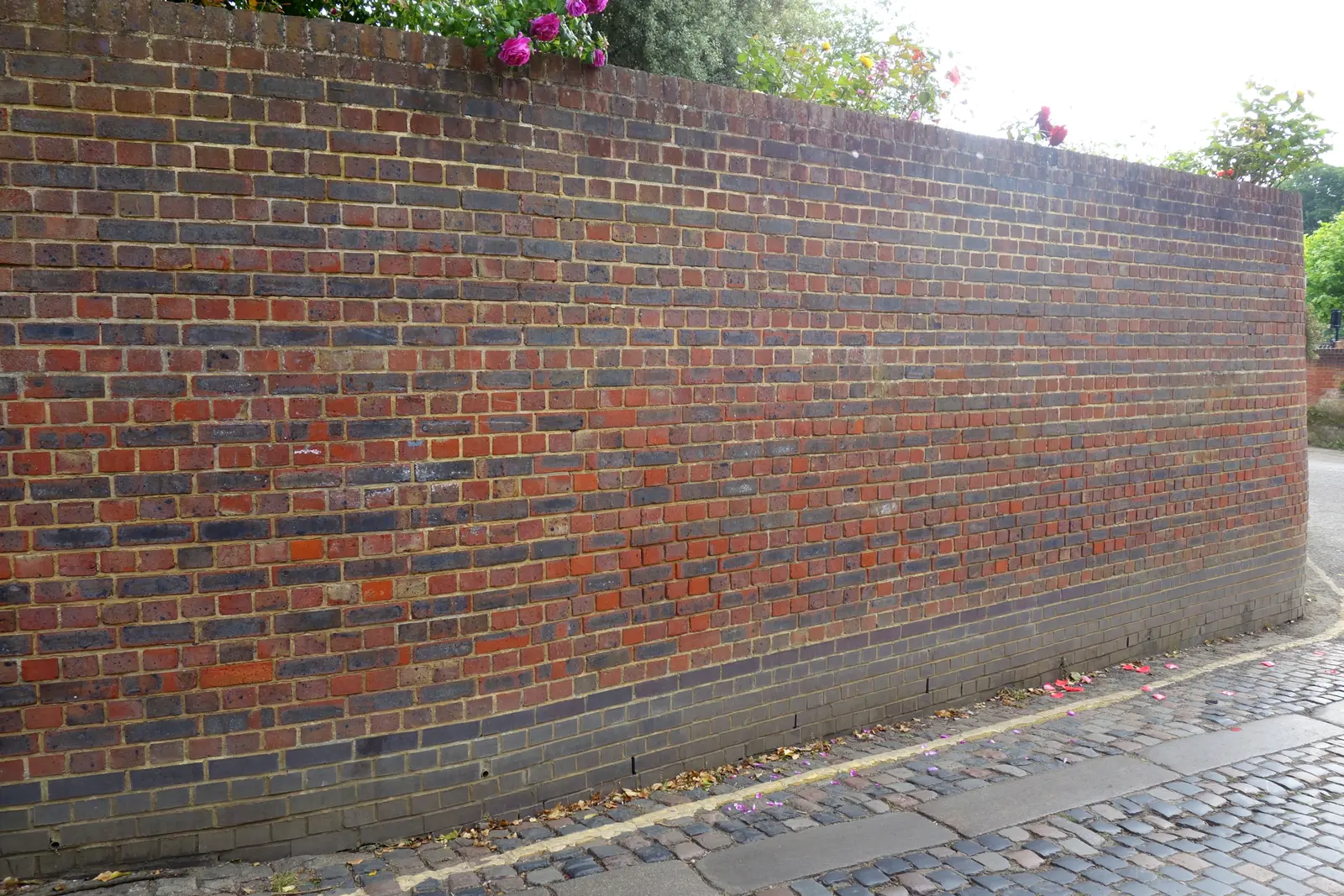
A curved brick wall beside a cobbled lane in Twickenham, London, photographed in 2024: courses of long faces alternate with courses of short ends, the pattern of English bond.
"Wall - Twickenham - London, UK - DSC07686" by Daderot — https://commons.wikimedia.org/wiki/File:Wall_-_Twickenham_-_London,_UK_-_DSC07686.jpg — CC0 1.0 (https://creativecommons.org/publicdomain/zero/1.0/)
Which bond is stronger? The 1883 manual gave its own answer as guidance for the builders of its day: “English bond is, upon the whole, to be preferred to Flemish bond for strength, as it contains a larger proportion of headers” (1883, p. 24).
It called appearance the only advantage claimed for Flemish bond, an appearance “which is preferred by many, and has led to its use in brick buildings of a superior class” (1883, p. 24). That is a historical opinion about how walls were built, not a judgment about any wall standing today.
The same page records one practical exception. “In 9-inch walls a better face can be shown on both sides by Flemish than by English bond, as the unequal length of headers causes a rough face when there are many of them” (1883, p. 24).
Appearance also explains a mixed bond that the manual names: “Single Flemish Bond consists of Flemish bond on one face of the wall, with English bond on the other” (1883, p. 22), laid so that the face looked like Flemish bond while the interior of the wall avoided the defects of Flemish bond.
Which bond is this?
Identifying a bond takes three questions, asked one course at a time and answered from the face alone. The same steps are written out in words below the drawing.
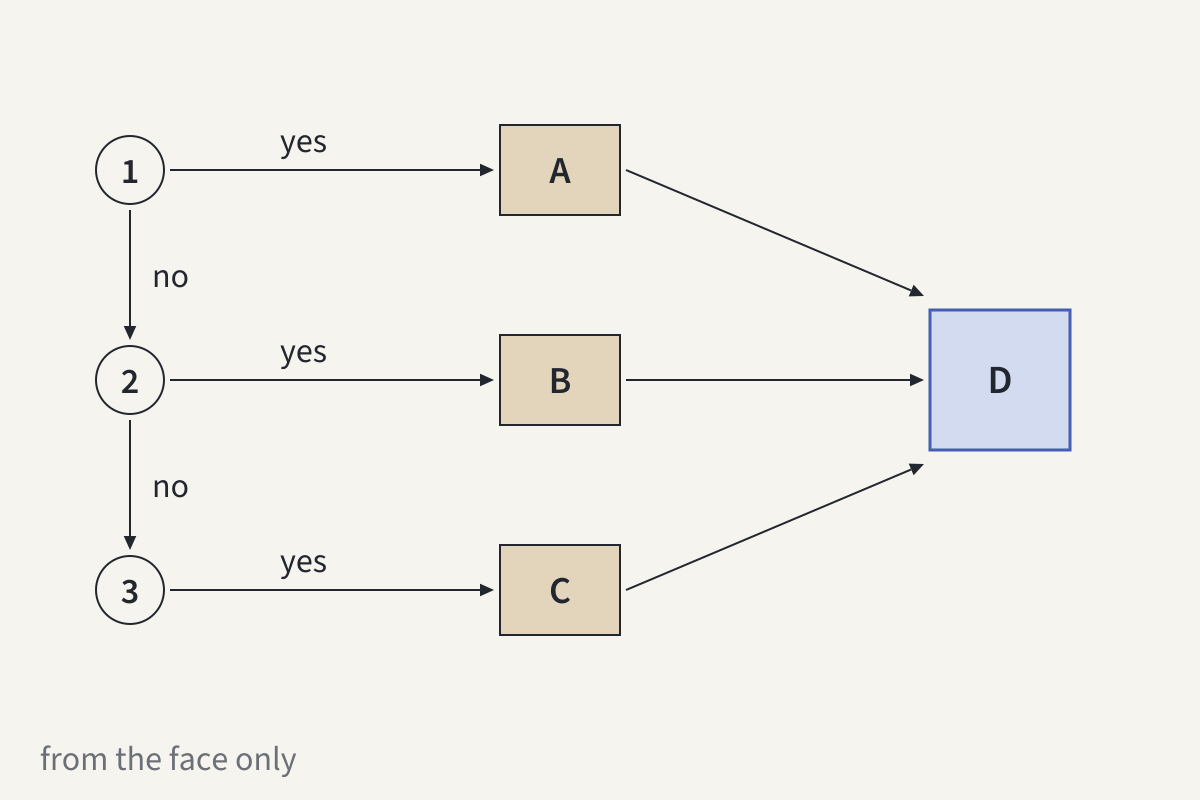
Three questions sort a brick face into Flemish, English or running bond; every answer ends at the same limit, because the face cannot show whether its short ends run through.
Basis Pattern rules from Notes on Building Construction, Part I (1883), pages 15 and 20; half-brick shift drawn for this page.
Legend: letters and numbers on the drawing
- 1 Does every course alternate short ends and long faces, each short end over the middle of a long face below?
- 2 Do whole courses of short ends lie between courses of long faces?
- 3 Are there long faces only, each course shifted by half a brick?
- A Flemish bond
- B English bond
- C running bond, which the 1883 manual calls stretching bond
- D the face cannot show whether the short ends are whole bricks
"Which bond is this? A flow for reading a brick face" by Built, Mapped & Planted, https://builtmappedandplanted.com/details/flemish-bond/ — CC BY 4.0, https://creativecommons.org/licenses/by/4.0/
- Follow one course with your eye. If short ends and long faces alternate all along it, and each short end sits over the middle of a long face below, the face is in Flemish bond.
- If not, compare neighboring courses. A course made entirely of short ends, lying between courses of long faces, identifies English bond.
- If every course shows only long faces, each shifted half a brick from the one below, the face is in running bond and displays no ties at all.
- Whatever the answer, stop there. A short end may be a whole header or a half-brick, and the face does not reveal which.
A face that fits none of the three questions is laid in some other bond; the manual mentions diagonal and herringbone bond among the patterns it leaves for its advanced course (1883, p. 24). The mortar can add a second, separate reading.
A patch where the joints are a different color from the rest of the wall is part of the maintenance signature, the visible clues that show who looks after a structure and how it has been kept up over time. Such a patch can point to a repair of that section, but not to who owns the wall or when the work was done, much as the letters cast into manhole covers name a maker or maintainer rather than an owner.
Carved stone raises a parallel question about whether a feature still does a job. The page on gargoyles and grotesques separates a working waterspout from an ornament that carries no water.
Cite this page
Built, Mapped & Planted. “Flemish vs English Bond: Headers Every Row or Every Other.” First issued 19 November 2026. https://builtmappedandplanted.com/details/flemish-bond/. Accessed on the day you read it.
Sources
- Notes on Building Construction, Part I, 2nd ed. (London: Rivingtons, 1883). archive.org/details/RivingtonsPart12ndEd1883Read: pages 13–15, 19–20, 22 and 24 read: brickwork terms, the different bonds, double and single Flemish bond, comparison of English and Flemish bond
How numbers and sources are checkedRedline sheet: all correctionsReport an error on this page (contact@builtmappedandplanted.com)
More sheets in Reading a Facade
A Comparison
Doric, Ionic, Corinthian: Vitruvius Named Three, Serlio Five
Picture credit
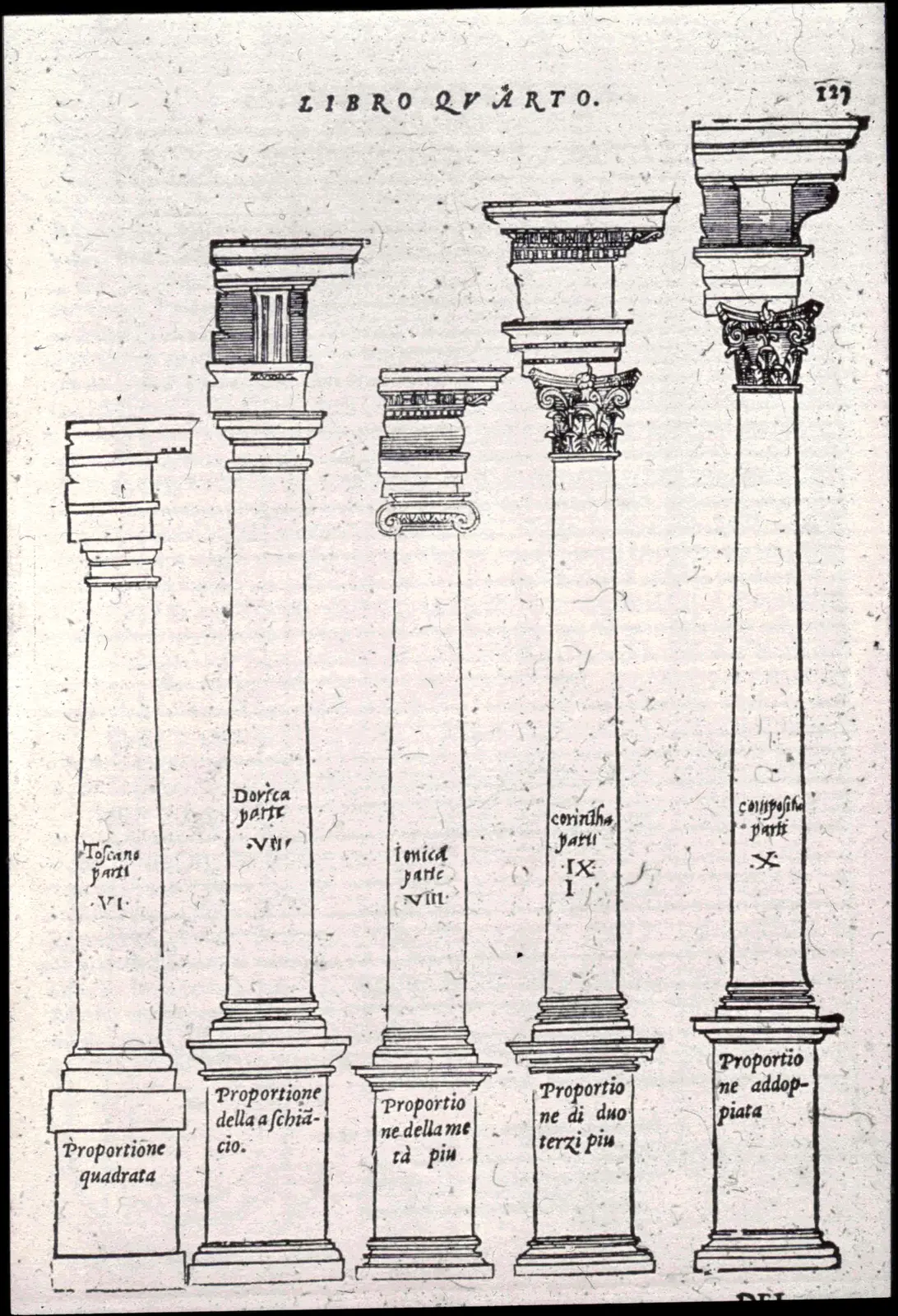
"Ordini architettonici: tuscanico, dorico, ionico, corinzio e composito, from Serlio's fourth book of architecture" by Sebastiano Serlio; slide by Henry A. Millon, Accademia delle Scienze di Torino — https://commons.wikimedia.org/wiki/File:Ordini_architettonici-_tuscanico,_dorico,_ionico,_corinizio_e_composito,_1537_-_Archivio_Accademia_delle_Scienze_Torino,_Millon_66_28_344.jpg — Public Domain (US: published before 1930; EU: author died 1554, more than 70 years ago (life plus 70 years); the scan is a faithful reproduction of a two-dimensional work)
A Field sheet entry
Gargoyle vs Grotesque: Strictly, a Gargoyle Is a Waterspout
Picture credit
"Etchings of Paris: The Gargoyle (Le Stryge), by Charles Meryon" by Charles Meryon — https://commons.wikimedia.org/wiki/File:Charles_Meryon_-_Etchings_of_Paris-_The_Gargoyle_-_1940.889_-_Cleveland_Museum_of_Art.jpg — CC0 1.0 (https://creativecommons.org/publicdomain/zero/1.0/)

A Comparison
Window Tax: Not Every Blocked-Up Window Was Dodging It
Picture credit
"A Vision of the Repeal of the Window Tax" by Wellcome Library, London. Wellcome Images — https://commons.wikimedia.org/wiki/File:A_Vision_of_the_Repeal_of_the_Window_Tax._Wellcome_M0012506.jpg — CC BY 4.0 (https://creativecommons.org/licenses/by/4.0/); modified: resized to 1,200 px wide