C Field sheet entry
Why Are Manhole Covers Round? Square Lids Can Fall In
The problem a lid has to close a shaft in the street without ever dropping into it.
Built, Mapped & Planted Issued
TL;DR
A round manhole cover a little wider than its opening cannot fall into the shaft, because a circle is equally wide in every direction. A square lid can slip in corner-first, since its narrowest width is about 0.71 of its diagonal. A Reuleaux triangle cannot fall in either, so the circle is one workable shape among several.
| Name | Manhole cover (access cover over a shaft) |
|---|---|
| Category | Under the Street |
| Where it appears | In streets and other paved surfaces, over the access shafts of sewers and storm drains |
| Original problem | Close an access shaft with a lid that cannot drop into it |
| Key dimensions or parameters | Access opening at least 24 in (610 mm) and manhole at least 48 in (1,200 mm) across, Ten States Standards (2014 edition, §34.3); narrowest over widest width: circle 1.00, square 0.71, triangle 0.87 (model) |
| Sources | Ten States Standards (2014 edition); EPA, Combined Sewer Overflow Basics (updated September 24, 2026); Commons file pages |
This block as data (CSV) where this data comes from
Data: Recommended Standards for Wastewater Facilities (Ten States Standards), 2014 edition, Great Lakes - Upper Mississippi River Board of State and Provincial Public Health and Environmental Managers, retrieved 2026-11-18; U.S. Environmental Protection Agency (EPA), Combined Sewer Overflow Basics (updated 2026-09-24), retrieved 2026-11-18; Wikimedia Commons file pages: A.-K. D. (CC0), Steven Pavlov (CC0), Panek (CC BY-SA 4.0), retrieved 2026-11-18
Model Model, not a survey of any building or real cover; a thin, rigid lid 5 percent larger than its opening, compared by outline only.
"Which lid shapes can drop through their own opening" by Built, Mapped & Planted, https://builtmappedandplanted.com/infrastructure/manhole-covers/ — CC BY 4.0, https://creativecommons.org/licenses/by/4.0/
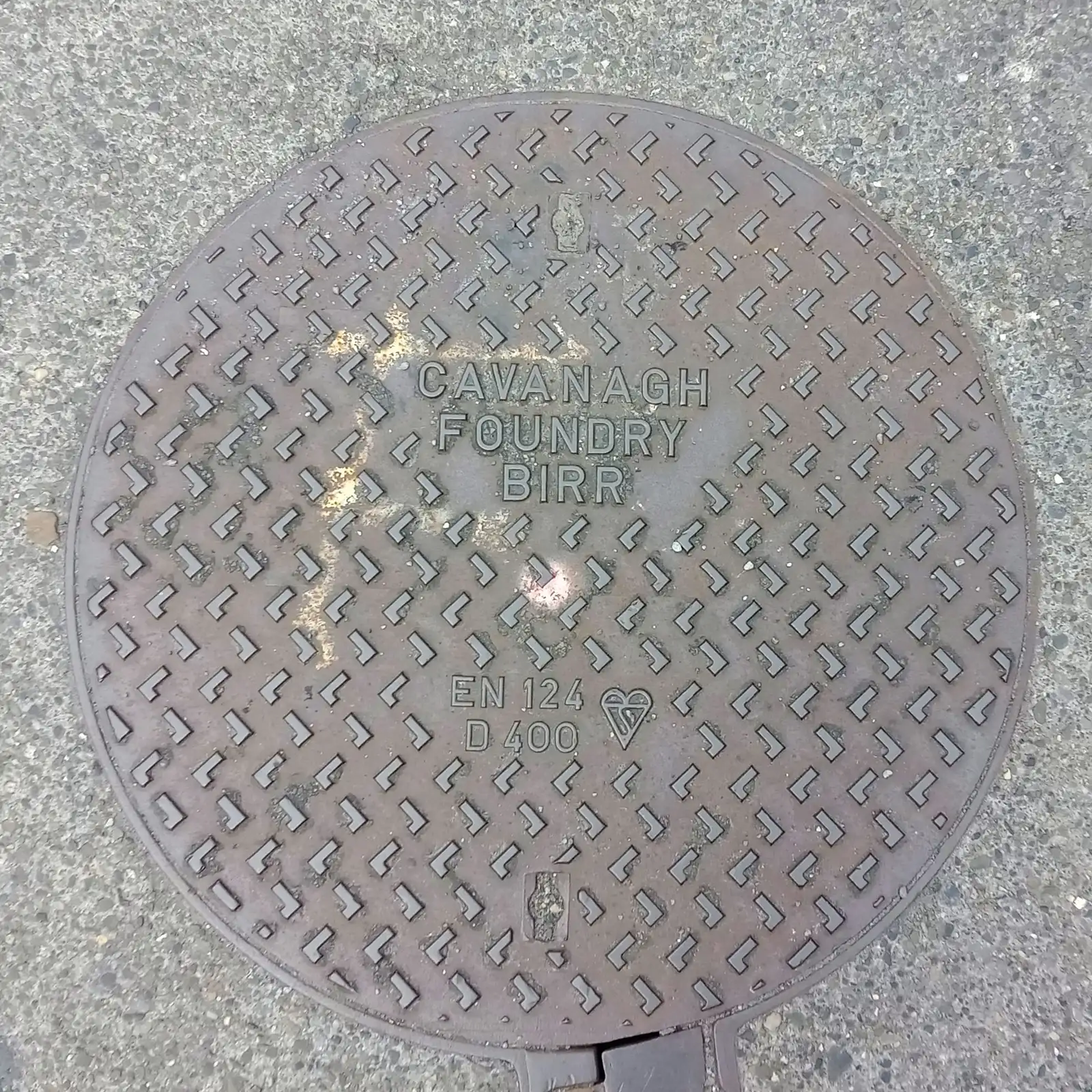
"Manhole cover by Cavanagh Foundry Birr" by A.-K. D. — https://commons.wikimedia.org/wiki/File:Manhole_cover_by_Cavanagh_Foundry_Birr.jpg — CC0 1.0 (https://creativecommons.org/publicdomain/zero/1.0/)
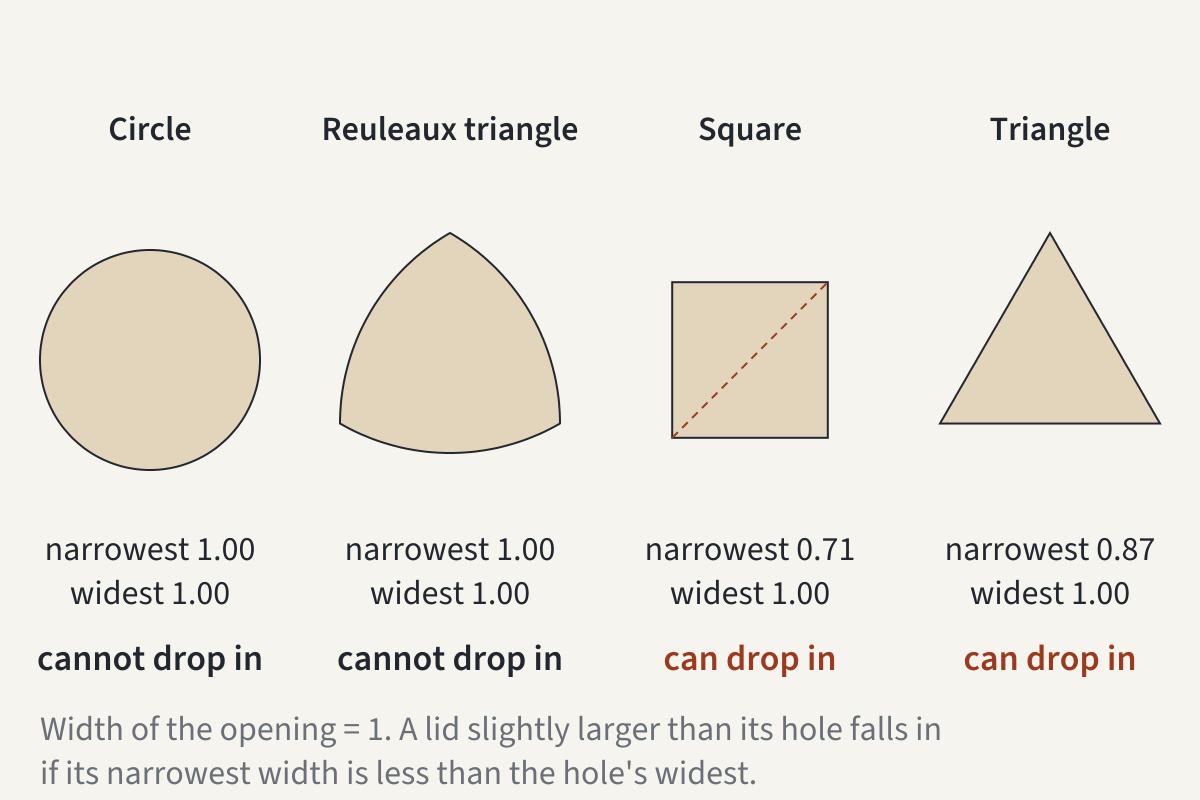
The drawing tests four lid shapes against an opening of the same shape; the picture is a round cover set in a paved surface in Kilkenny, Ireland, cast with the name of Cavanagh Foundry, Birr.
Basis Widths found by projecting each outline in 3,600 directions.
From the curb, look at a round manhole cover: it is the lid of an access shaft. Below it may run a sewer, a storm drain or a combined sewer, a system in which, as the U.S. Environmental Protection Agency puts it, “both wastewater and stormwater flow through the same pipes.” The cover in the photograph sits in a paved surface in Kilkenny, and its cast letters name Cavanagh Foundry, Birr. The drawing puts that round outline to the test.
Which shapes can fall through their own hole?
A lid can drop into its hole only if it can be turned so that its narrowest width fits through the opening's widest width. The drawing tests four outlines that way. Each outline was projected onto 3,600 directions to find its narrowest and widest width, with the opening's widest width set to 1 and each lid assumed to be 5 percent larger than its opening in every direction.
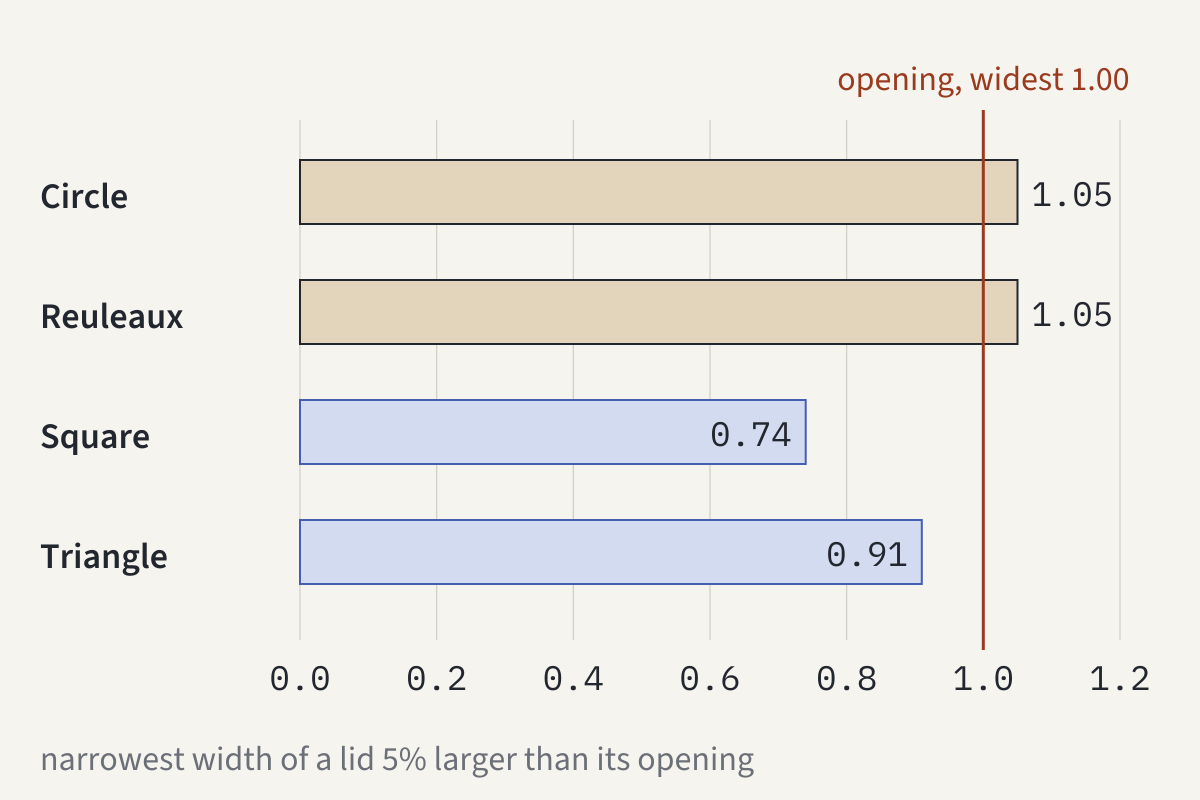
A circle measures 1.00 in every direction, so a round lid stays 1.05 wide however it is turned and cannot pass. A square behaves differently. Its widest width is the diagonal and its narrowest is the side, about 0.71 of the diagonal; in this model the lid's side comes to 0.74 of the opening's diagonal, so the lid can slip in corner-first. An equal-sided triangle drops in the same way, along its height: about 0.87 of its side, or 0.91 for the larger lid.
The fourth shape is the surprise. A Reuleaux triangle, a curved triangle whose three sides are arcs each centered on the opposite corner, is as wide in every direction as a circle: 1.00 by the same projection test. A Reuleaux lid 5 percent larger than its opening cannot drop in either, so in this model the circle is not the only shape that passes the test.
Model Model, not a survey of any building or real cover; a thin, rigid lid 5 percent larger than its opening, compared by outline only.
The narrowest width of each lid, assumed 5 percent wider than its opening, against the opening's widest width of 1.00; a bar that stops short of the line belongs to a lid that can drop in.
Basis Widths found by projecting each outline in 3,600 directions.
"Narrowest lid width against the opening's widest width" by Built, Mapped & Planted, https://builtmappedandplanted.com/infrastructure/manhole-covers/ — CC BY 4.0, https://creativecommons.org/licenses/by/4.0/
| Shape | Narrowest width | Widest width | Lid 5 percent larger than its opening (model): can it drop in? |
|---|---|---|---|
| Circle | 1.00 | 1.00 | no |
| Reuleaux triangle | 1.00 | 1.00 | no |
| Square | 0.71 | 1.00 | yes, corner-first |
| Triangle | 0.87 | 1.00 | yes, along its height |
Download the shape widths (CSV) (where this data comes from)
A worked example puts the ratio at street size. The 2014 Ten States Standards call for an access opening at least 24 inches across (§34.3). In this model a square opening 24 inches on a side has a diagonal of about 33.9 inches, while a lid 5 percent larger is only 25.2 inches on a side, so that lid could pass along the diagonal; a round lid of 25.2 inches over a 24-inch round opening could not.
Are all manhole covers round?
No. Square covers are in use, like the one below in Ljubljana, Slovenia. The geometry does not say why a given street has square lids; it says only that such a lid could slip in corner-first if it were lifted clear of its frame and turned on edge, which a round lid cannot do. Covers are lifted only by trained crews following set procedures.
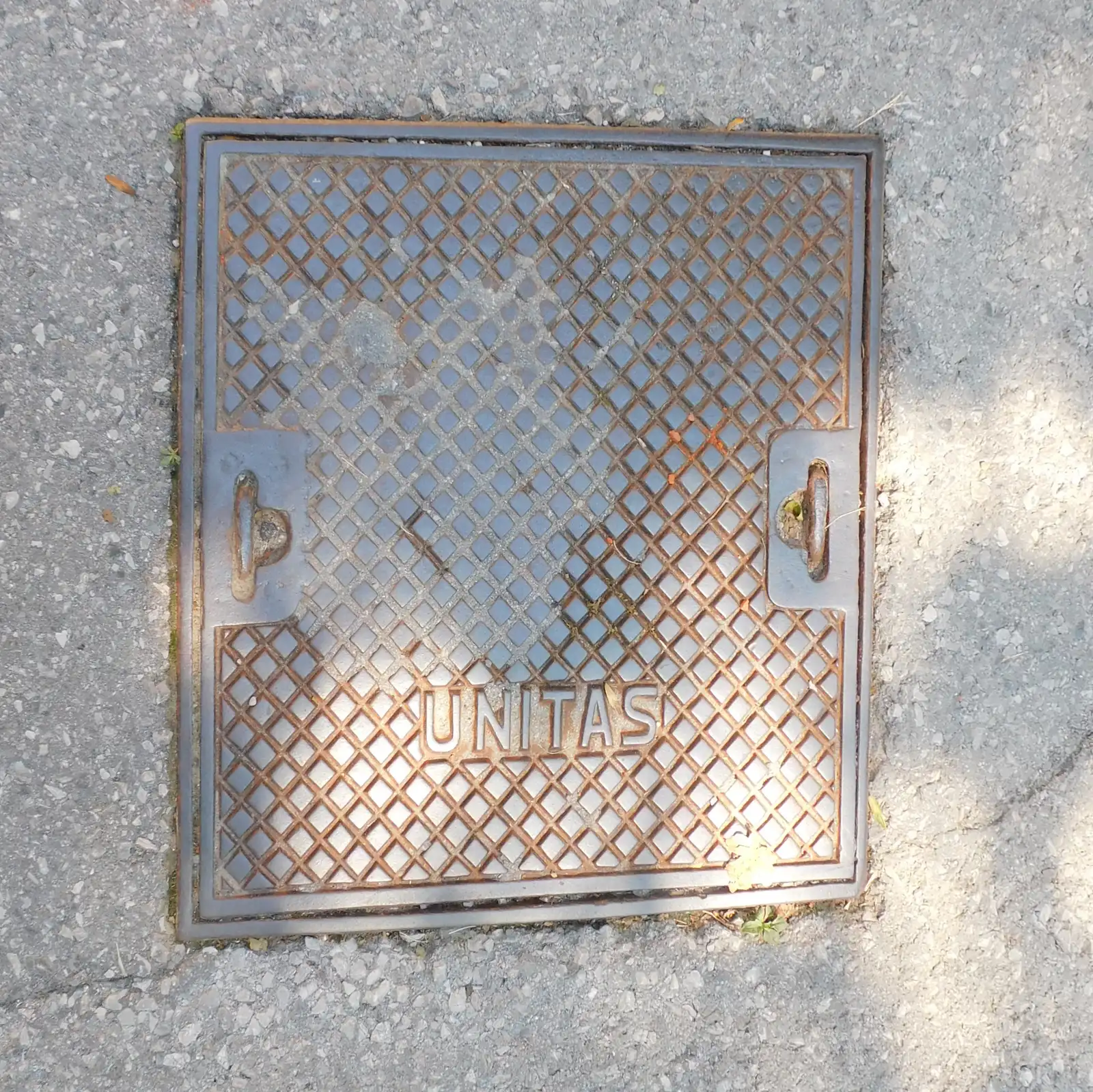
A square cover in Ljubljana, Slovenia, seated in a square frame and cast with the word UNITAS.
"Square manhole cover, Ljubljana (UNITAS)" by Panek — https://commons.wikimedia.org/wiki/File:Square_manhole_cover_ljubljna_unitas.jpg — CC BY-SA 4.0 (https://creativecommons.org/licenses/by-sa/4.0/)
How does the lid sit in its frame?
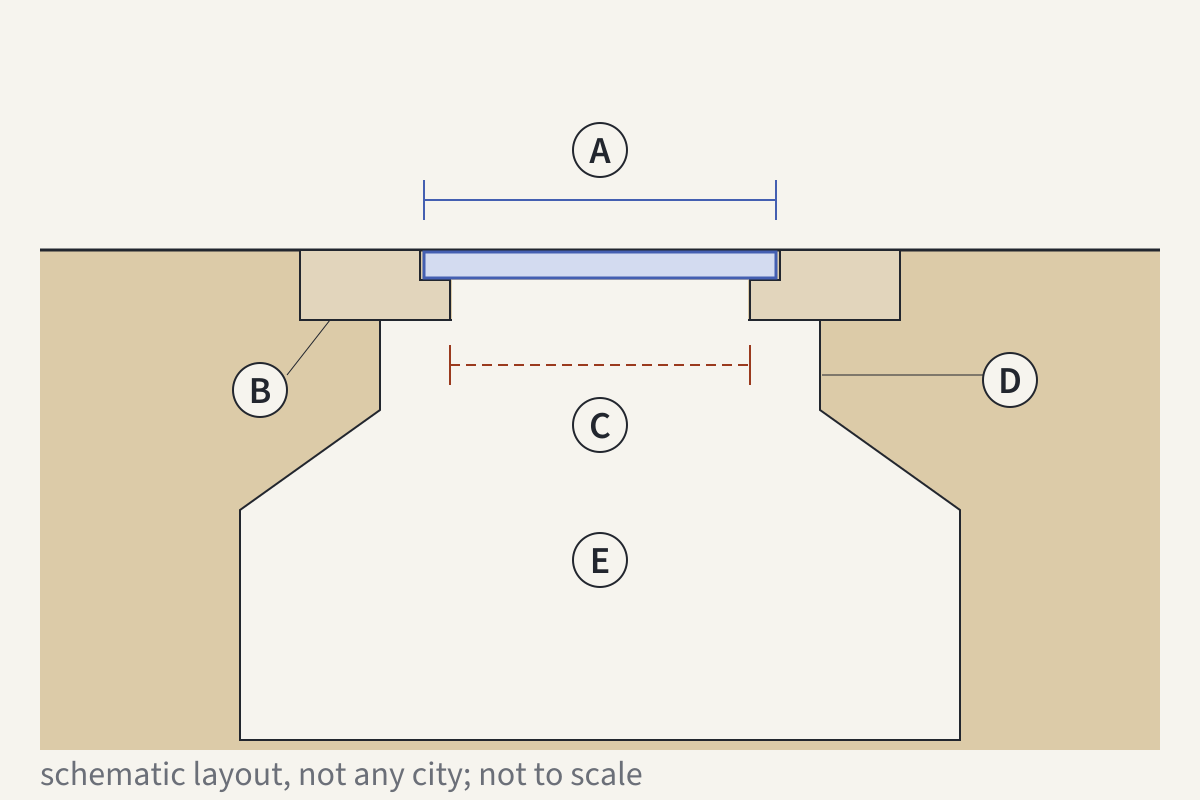
In the drawing, lid A rests on a ledge cast in frame B, and the clear opening C under the lid is narrower than the lid itself. That overlap alone does not keep a lid out: it still drops through if its narrowest width is less than the opening's widest width, as a square's is. A round lid also has no corners to line up, so it fits its ledge at any angle. A square lid fits its frame only when its sides line up with the frame's.
Model schematic layout, not any city
A schematic section through a cover and its frame: the lid rests on a ledge, and the clear opening under it is narrower than the lid.
Basis Lid over ledge as assumed in the shape test; the shaft top is drawn narrower than the chamber, a layout that fits the two minimum sizes in Ten States Standards (2014 edition, §34.3), with no dimensions.
Legend: letters and numbers on the drawing
- A lid
- B frame and its ledge
- C clear opening
- D shaft top
- E chamber
"Cover and frame, section (schematic)" by Built, Mapped & Planted, https://builtmappedandplanted.com/infrastructure/manhole-covers/ — CC BY 4.0, https://creativecommons.org/licenses/by/4.0/
Data: Recommended Standards for Wastewater Facilities (Ten States Standards), 2014 edition, Great Lakes - Upper Mississippi River Board of State and Provincial Public Health and Environmental Managers, retrieved 2026-11-18
The 2014 Ten States Standards set two different sizes for a sewer manhole: a manhole diameter of at least 48 inches (1,200 mm) and an access opening of at least 24 inches (610 mm), both in §34.3. The drawing follows those two figures in showing the shaft top D narrower than the chamber E below it, though the standard sets only a minimum for each.
The same standard asks for watertight covers wherever a manhole top may be flooded by street runoff or high water (§34.6). Covers are lifted, and shafts entered, only by trained crews following set procedures.
Reading the letters on a cover
The cover in the photograph, filed on Wikimedia Commons as a sewer manhole cover by Hern Iron Works and photographed in 2011, carries three lines of cast lettering. HERN IRON WORKS names the maker, SEWER names the kind of pipe below, and C D A IDAHO is a place name. Nothing on the face of the cover says whether that place is the foundry's town or the town that looks after the sewer.
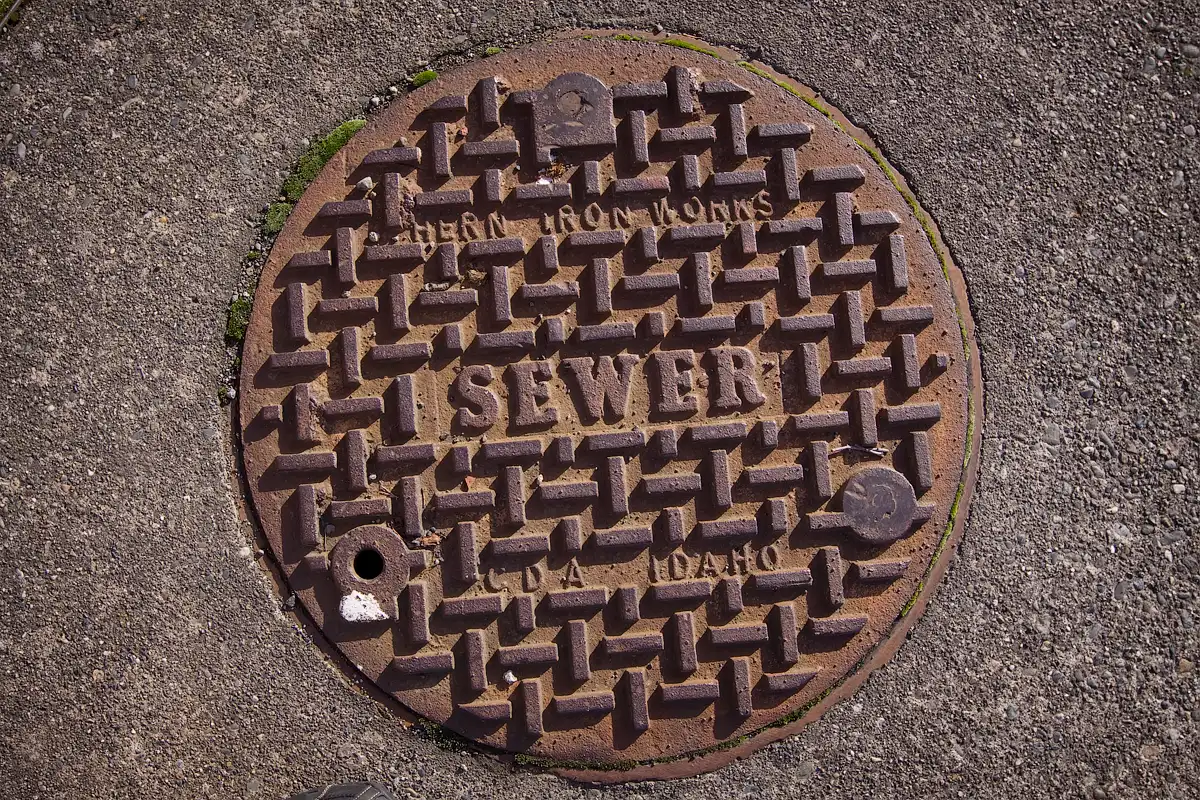
A round sewer cover photographed in 2011, cast with the words HERN IRON WORKS, SEWER and C D A IDAHO.
"Sewer Manhole Cover by Hern Iron Works" by Steven Pavlov — https://commons.wikimedia.org/wiki/File:Sewer_Manhole_Cover.jpg — CC0 1.0 (https://creativecommons.org/publicdomain/zero/1.0/)
The Kilkenny cover at the top of the page reads differently. CAVANAGH FOUNDRY BIRR gives a maker and a town, and no word on it names the pipe. A sewer carries wastewater away from buildings; the other half of a town's water system, above ground, is the subject of water towers.
The maintenance signature
Marks like these are what this site calls the maintenance signature: the visible clues that show who looks after a structure and how it has been kept up over time. On a cover, the clues are the kind of pipe, a maker or maintainer, a place name and sometimes a year. A maintenance signature does not settle ownership: the name on a lid can belong to a foundry, a contractor or an agency, and who owns a pipe is a matter for deeds and utility records.
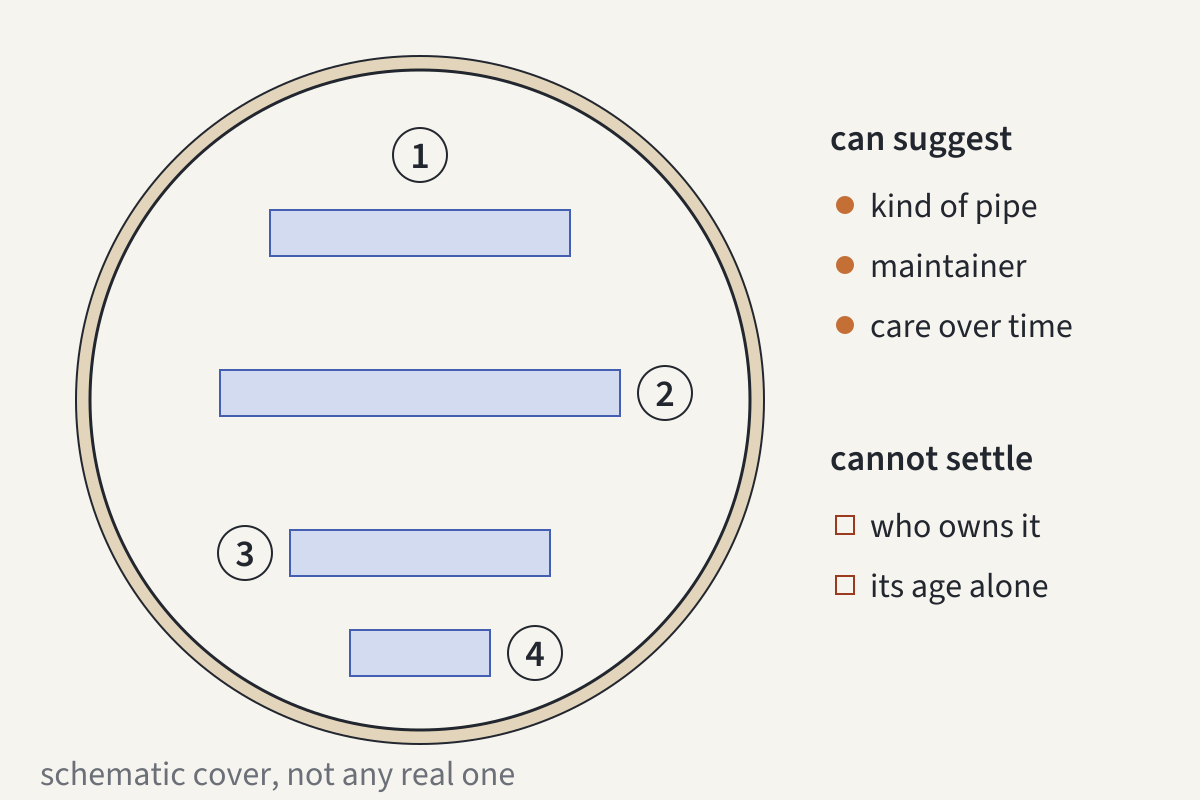
A schematic cover with four kinds of cast mark numbered: the kind of pipe, the maker, a place name and, on some covers, a year.
Basis Mark types taken from the two photographed covers and the definition of the term; schematic, not any real cover.
Legend: letters and numbers on the drawing
- 1 kind of pipe
- 2 maker or maintainer
- 3 place name
- 4 year, on some covers
"Reading the marks on a cover (schematic)" by Built, Mapped & Planted, https://builtmappedandplanted.com/infrastructure/manhole-covers/ — CC BY 4.0, https://creativecommons.org/licenses/by/4.0/
| Mark | What it can suggest | What it cannot settle |
|---|---|---|
| Kind of pipe, such as SEWER | what runs below | the route or depth of the pipe |
| Maker or maintainer, such as HERN IRON WORKS | who cast the cover or who looks after it | who owns the pipe |
| Place name, such as C D A IDAHO | a town tied to the maker or the maintainer | which of the two it is |
| Year, on some covers | when that cover was cast | the age of the shaft or the pipe |
A single mark is no proof of age either. A cover can be replaced, so a year cast on it, if there is one, says nothing certain about the shaft or the pipe below. Neither photograph here shows a year. An older piece of street equipment, a hand pump in 1854 London whose water John Snow's evidence put before the parish board, is the subject of the Broad Street pump.
Cite this page
Built, Mapped & Planted. “Why Are Manhole Covers Round? Square Lids Can Fall In.” First issued 19 November 2026. https://builtmappedandplanted.com/infrastructure/manhole-covers/. Accessed on the day you read it.
Sources
- U.S. Environmental Protection Agency, “Combined Sewer Overflow Basics,” National Pollutant Discharge Elimination System (NPDES), page last updated September 24, 2026. www.epa.gov/npdes/combined-sewer-overflow-bas…Read: full pageText license: U.S. Government work (17 U.S.C. §105) (terms)
- Great Lakes - Upper Mississippi River Board of State and Provincial Public Health and Environmental Managers, Recommended Standards for Wastewater Facilities (Ten States Standards), 2014 edition. www.health.mn.gov/communities/environment/water/doc…Read: chapter 30 (sections 31 to 38, including section 34 on manholes) and chapter 40 (sections 41, 42 and 49) read; figures quoted from the 2014 editionText license: 2014 edition: this document, or portions thereof, may be reproduced without permission if credit is given to the Board and to this publication as a source (terms)
How numbers and sources are checkedRedline sheet: all correctionsReport an error on this page (contact@builtmappedandplanted.com)
More sheets in Under the Street
C Diagram deep-dive
Roman Aqueducts: By Frontinus’s Count, Mostly Underground
Picture credit
"Le Pont du Gard, by Hubert Robert" by Hubert Robert — https://commons.wikimedia.org/wiki/File:Le_pont_du_Gard_-_Hubert_Robert_-_Mus%C3%A9e_du_Louvre_Peintures_INV_7650.jpg — Public Domain (US: published before 1931; EU: artist died 1808, more than 70 years ago (life plus 70 years); faithful reproduction of a two-dimensional work)
C Diagram deep-dive
How Does a Sewer System Work? Sometimes Rain Shares the Pipe
Picture credit
"Curb inlet and catch basin" by Mds08011 — https://commons.wikimedia.org/wiki/File:Curb_inlet_and_catch_basin.jpg — CC BY 4.0 (https://creativecommons.org/licenses/by/4.0/)
C Field sheet entry
How Water Towers Work: Pressure Comes From Height
Picture credit
"General view of the standpipe, with Pumping Station No. 1, from the HAER record of the Louisville Water Company Pumping Stations" by Jack Boucher and William G. Johnson, Historic American Engineering Record (HAER), National Park Service (NPS) — https://commons.wikimedia.org/wiki/File:General_view_of_the_standpipe,_with_Pumping_Station_No._1_to_the_left._-_Louisville_Water_Company_Pumping_Stations,_Zorn_Avenue_and_River_Road,_Louisville,_Jefferson_County,_KY_HAER_KY,56-LOUVI,72-7.tif — Public Domain (US: U.S. Government work (17 U.S.C. §105), Historic American Engineering Record (HAER) photograph, photographers listed as Jack Boucher and William G. Johnson; EU: no statutory public-domain basis; National Park Service (NPS) statement: "Materials created for HABS, HAER, or HALS are in the public domain."); modified: converted from TIFF to JPEG at full size