C Field sheet entry
How Water Towers Work: Pressure Comes From Height
The problem the pipes of a town need steady pressure even when everyone turns on a tap at the same time.
Built, Mapped & Planted Issued
TL;DR
A water tower works by height. The pressure in the pipes below comes from how far the tank's water surface stands above each tap: about 0.433 psi for every foot of still fresh water at about 15 °C, by this site's calculation. A tap 100 feet below the surface sees about 43.3 psi in water at that temperature.
| Name | Water tower (elevated storage tank or standpipe) |
|---|---|
| Category | Under the Street |
| Where it appears | On legs or a pedestal above a town, as a tall standpipe, or as tanks on the roofs of tall buildings |
| Original problem | Keep water pressure in the pipes steady while use rises and falls |
| Key dimensions or parameters | About 0.433 psi of pressure per foot of still fresh water at 15 °C; 43.3 psi under 100 ft (calculation) |
| Sources | AWWA issue paper for EPA (2002); NYC Health tank page (read 2026-11-18); HAER record KY,56-LOUVI,72-7; Commons file pages |
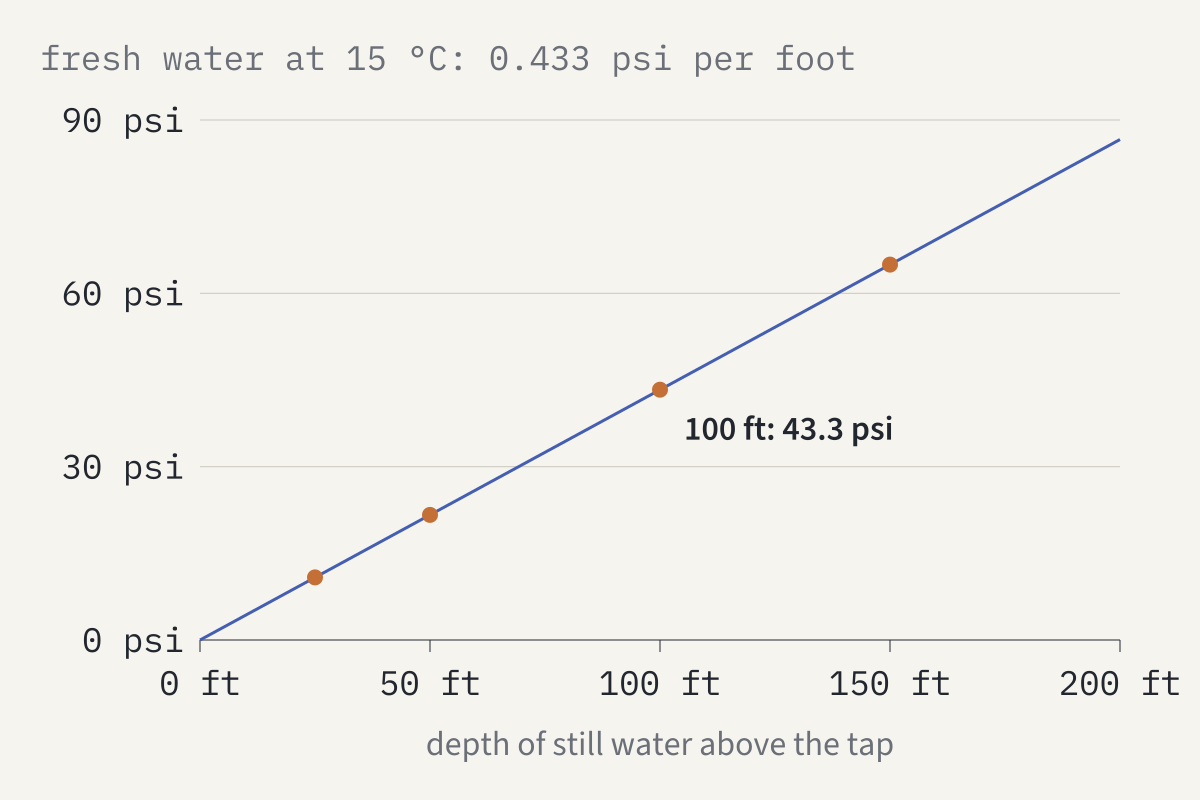
"Pressure under still water by depth" by Built, Mapped & Planted, https://builtmappedandplanted.com/infrastructure/water-towers/ — CC BY 4.0, https://creativecommons.org/licenses/by/4.0/
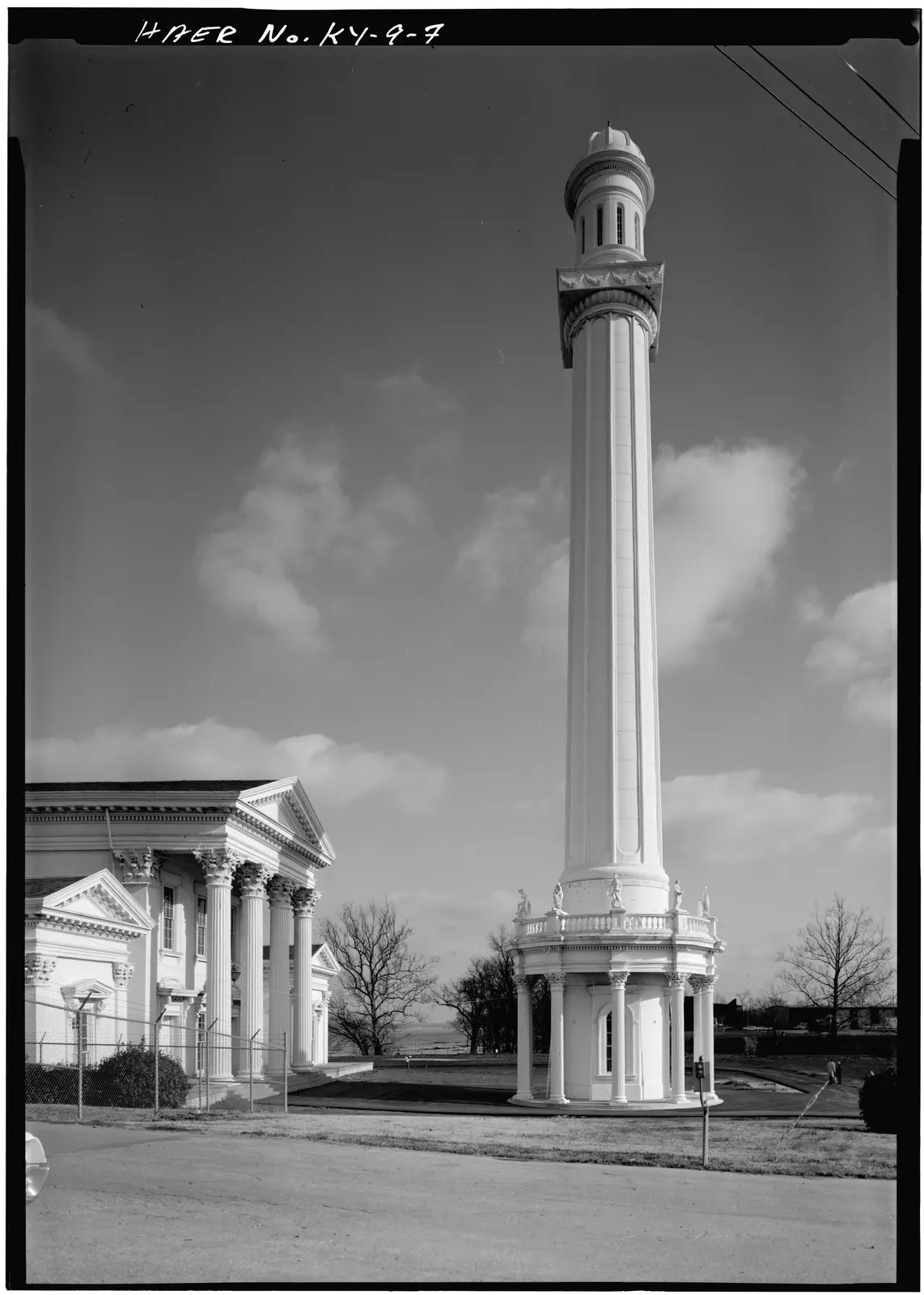
“General view of the standpipe, with Pumping Station No. 1, from the HAER record of the Louisville Water Company Pumping Stations”, Jack Boucher and William G. Johnson, Historic American Engineering Record (HAER), National Park Service (NPS); public domain.
Full credit
"General view of the standpipe, with Pumping Station No. 1, from the HAER record of the Louisville Water Company Pumping Stations" by Jack Boucher and William G. Johnson, Historic American Engineering Record (HAER), National Park Service (NPS) — https://commons.wikimedia.org/wiki/File:General_view_of_the_standpipe,_with_Pumping_Station_No._1_to_the_left._-_Louisville_Water_Company_Pumping_Stations,_Zorn_Avenue_and_River_Road,_Louisville,_Jefferson_County,_KY_HAER_KY,56-LOUVI,72-7.tif — Public Domain (US: U.S. Government work (17 U.S.C. §105), Historic American Engineering Record (HAER) photograph, photographers listed as Jack Boucher and William G. Johnson; EU: no statutory public-domain basis; National Park Service (NPS) statement: "Materials created for HABS, HAER, or HALS are in the public domain."); modified: converted from TIFF to JPEG at full size
The drawing plots the pressure under still fresh water against its depth; the picture is the standpipe tower of the Louisville Water Company, photographed for the Historic American Engineering Record.
Basis Pressure computed as density times gravity times height for fresh water at about 15 °C.
Across flat farmland, a steel ball on legs can mark where a town is. According to a 2002 issue paper that the American Water Works Association prepared for the U.S. EPA, elevated storage most often takes the form of an elevated steel tank or a standpipe, which the paper describes as a tall cylindrical tank. Both raise a water surface high above the pipes.
Some were built to be looked at. The Historic American Engineering Record describes the Louisville standpipe tower as 169 feet high, with a ring of Corinthian columns around its base, brick to the top of that colonnade and riveted steel plates above, designed in imitation of a triumphal Roman Doric column. A plain steel tank on a pedestal answers the same problem, and it deserves the same close reading as a cathedral.
How much pressure does each foot add?
Pressure at the bottom of still water is the weight of the water above, spread over each square inch. That makes it a simple product: density times gravity times height. Taking fresh water at 15 °C as 999.103 kilograms per cubic meter, each foot of water adds 0.4331 psi at about 15 °C, or about 9.8 kilopascals per meter, in this site's calculation.
The figure barely moves with temperature. At 4 °C the factor is 0.434 psi per foot and at 20 °C it is 0.433, so the rounded 0.43 holds from 4 °C to 20 °C.
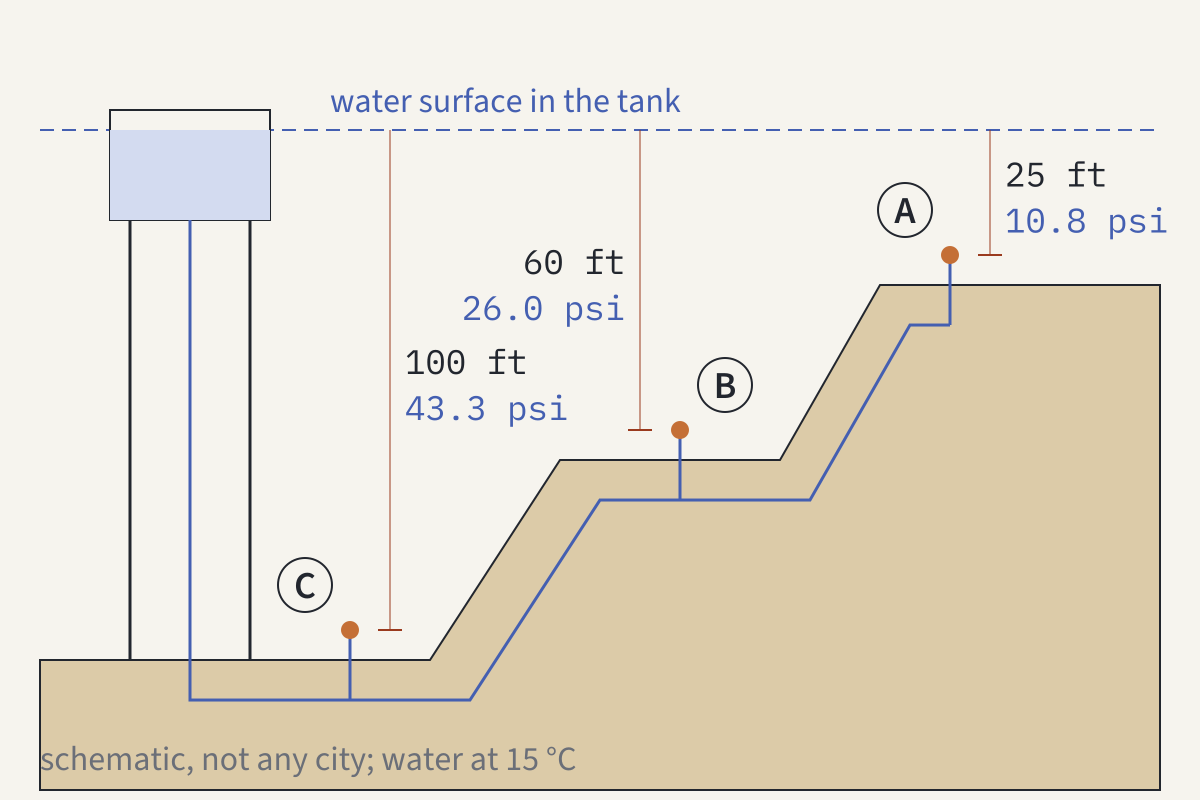
What counts is the height of the water surface above the tap. The width of the tank and the route of the pipe in between do not change the number. In the drawing, three taps hang off one main at different depths below the same surface.
Model schematic layout, not any city
Three taps below one water surface: the deeper a tap sits under that surface, the higher its pressure, whatever the shape of the pipe between them.
Basis Pressure computed as density times gravity times height for fresh water at about 15 °C; heights in the drawing are schematic.
Legend: letters and numbers on the drawing
- A tap on the high ground, 25 feet below the water surface
- B tap on the middle ground, 60 feet below
- C tap at the foot of the tower, 100 feet below
"Pressure at three taps below one water surface" by Built, Mapped & Planted, https://builtmappedandplanted.com/infrastructure/water-towers/ — CC BY 4.0, https://creativecommons.org/licenses/by/4.0/
| Height of water above the tap | Pressure at 15 °C | At 4 °C | At 20 °C |
|---|---|---|---|
| 25 ft | 10.8 psi | 10.8 psi | 10.8 psi |
| 50 ft | 21.7 psi | 21.7 psi | 21.6 psi |
| 100 ft | 43.3 psi | 43.4 psi | 43.3 psi |
| 150 ft | 65.0 psi | 65.0 psi | 64.9 psi |
Download the height and pressure table (CSV) (where this data comes from)
These are calculations for still water, not readings from any tower. The table says nothing about the pressure while water is flowing through the pipes.
Why are water towers so tall?
Water towers are tall because the height of the water surface is what sets the pressure. A tank sitting on the ground can hold plenty of water, yet it pushes on taps at its own level only with the depth of water inside it. The 2002 issue paper (section 1.0, p. 1) notes that ground-level tanks may need pump stations if they are “not built at elevations providing the required system pressure by gravity.”
The same paper draws a line inside a standpipe. Only the part of its water that sits high enough to supply the required system pressure counts as useful storage for evening out pressure; the lower part holds up that column and serves as an emergency supply. A tower on high ground or on tall legs puts more of its water above that line.
Why the water level rises and falls
A tower's water level is not fixed. The issue paper says storage has historically been built to even out demand, damp pressure swings in the pipes, and hold reserves for fire fighting, power outages and other emergencies. The tank takes up the difference between what the pumps send and what the town draws.
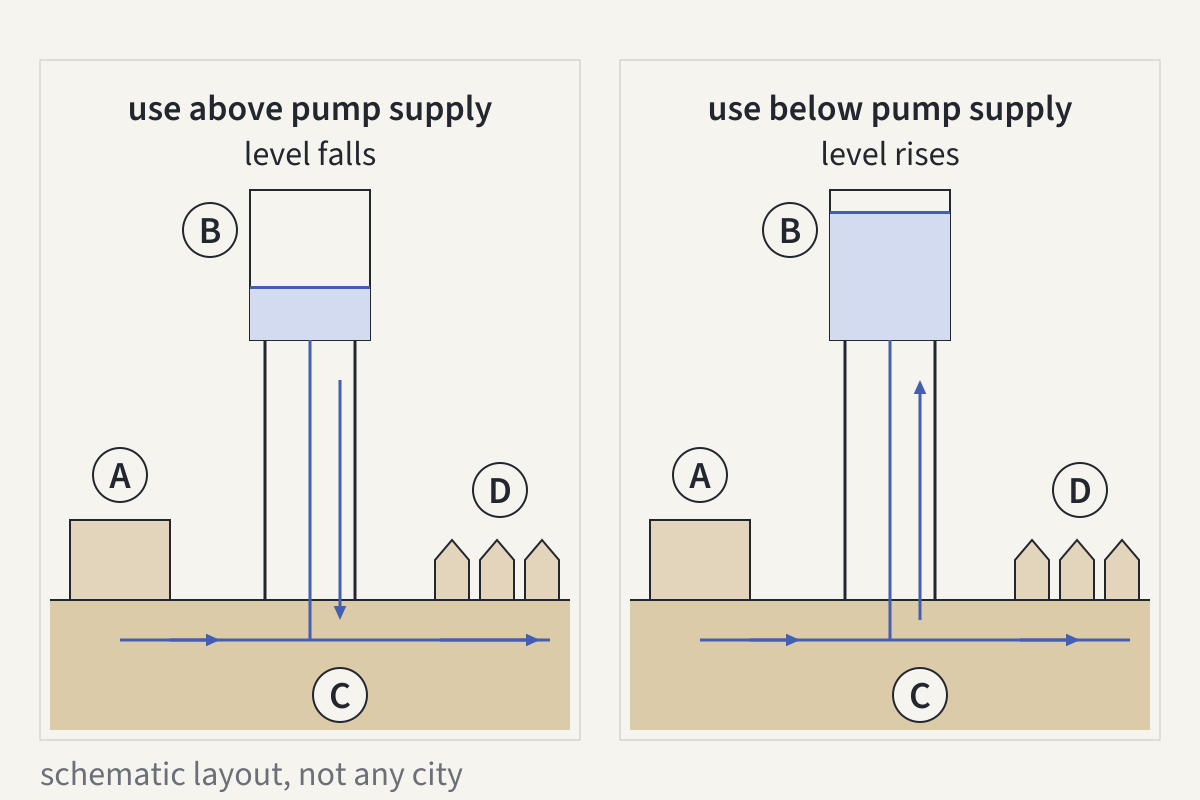
Model schematic layout, not any city
When the town uses more water than the pumps send, the tank level falls; when it uses less, the surplus flows back up into the tank.
Basis Roles of storage from the 2002 AWWA issue paper for EPA (section 1.0); the flows are drawn as a balance of supply and use.
Legend: letters and numbers on the drawing
- A pump station
- B elevated tank
- C water mains
- D homes and businesses
"Why the tank level rises and falls (schematic)" by Built, Mapped & Planted, https://builtmappedandplanted.com/infrastructure/water-towers/ — CC BY 4.0, https://creativecommons.org/licenses/by/4.0/
How the levels are run is a whole-system matter. The paper says water level changes are managed across pressure zones and service areas rather than tank by tank. It reports a Philadelphia study of standpipes which concluded that drawdown needs to match or come before peak demand for stored water to get out into the pipes.
The rise and fall also matters for water quality. The paper says the age of stored water is managed by turning it over and letting tank levels move, and it cites a recommendation of a complete turnover every 3 to 5 days as a starting point (Kirmeyer and others, 1999), with each tank given its own goal.
What happens as the level drops?
The pressure drops with it. Every foot the water surface falls takes about 0.433 psi off every tap below it, for water at about 15 °C. In this calculation a drawdown of 20 feet lowers the pressure at all three taps in the drawing by about 8.7 psi.
Tanks on city roofs
The same rule works on a single building. As of November 2026, the New York City Health Department's tank inspection page says that buildings of more than six floors use pumps to fill rooftop tanks, which hold the water until it is drawn. From there the water runs down to the floors below, and a faucet 30 feet below the tank's water surface would see about 13.0 psi in this calculation, for still water at about 15 °C.
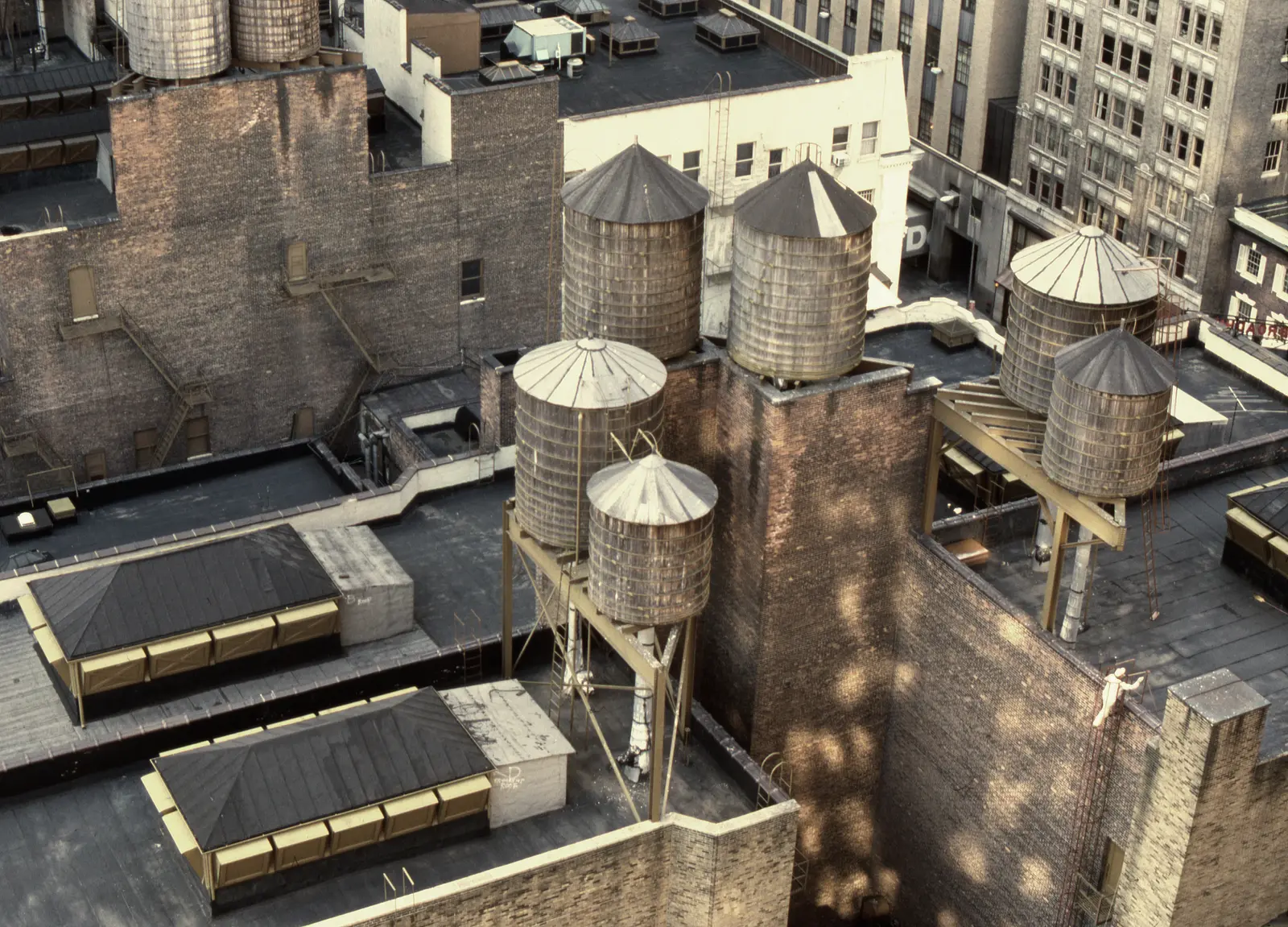
Wooden tanks on steel stands and brick bases above the rooftops of West 44th Street, Manhattan, photographed in June 1984 from a hotel room 20 floors up.
"Water Towers On 44th Street - June 1984" by TedQuackenbush — https://commons.wikimedia.org/wiki/File:Water_Towers_On_44th_Street_-_June_1984.jpg — CC BY-SA 3.0 (https://creativecommons.org/licenses/by-sa/3.0/)
The department also requires owners of buildings that use tanks for drinking water to have them inspected at least once a year. The inspection is work for a licensed master plumber, someone under a master plumber's direct supervision, or a licensed engineer or architect. The water a tank sends down eventually leaves the building through the drains described in how a sewer system works, and the shafts along those pipes are closed by manhole covers.
Cite this page
Built, Mapped & Planted. “How Water Towers Work: Pressure Comes From Height.” First issued 19 November 2026. https://builtmappedandplanted.com/infrastructure/water-towers/. Accessed on the day you read it.
Sources
- American Water Works Association, with Economic and Engineering Services, Inc., Finished Water Storage Facilities, Distribution System Issue Paper prepared for the U.S. Environmental Protection Agency, Office of Ground Water and Drinking Water (August 15, 2002). www.epa.gov/sites/default/files/2015-09/docum…Read: full text read
- NYC Department of Health and Mental Hygiene, Drinking Water Tank Inspection Reporting (web page). www.nyc.gov/site/doh/business/permits-and-lic…Read: full page read; no update date shown on the pageText license: © City of New York; all rights reserved (facts cited, text not reproduced) (terms)
- Historic American Engineering Record, Louisville Water Company Pumping Stations, Zorn Avenue and River Road, Louisville, Jefferson County, KY, HAER KY-9 (HAER KY,56-LOUVI,72-), photograph 7 and significance statement, as transcribed on the Wikimedia Commons file page. commons.wikimedia.org/wiki/File:General_view_of_the_sta…Read: file page only (record transcription); Library of Congress record not readText license: U.S. Government work (17 U.S.C. §105) (terms)
How numbers and sources are checkedRedline sheet: all correctionsReport an error on this page (contact@builtmappedandplanted.com)
More sheets in Under the Street
C Diagram deep-dive
Roman Aqueducts: By Frontinus’s Count, Mostly Underground
Picture credit
"Le Pont du Gard, by Hubert Robert" by Hubert Robert — https://commons.wikimedia.org/wiki/File:Le_pont_du_Gard_-_Hubert_Robert_-_Mus%C3%A9e_du_Louvre_Peintures_INV_7650.jpg — Public Domain (US: published before 1931; EU: artist died 1808, more than 70 years ago (life plus 70 years); faithful reproduction of a two-dimensional work)

C Diagram deep-dive
How Does a Sewer System Work? Sometimes Rain Shares the Pipe
Picture credit
"Curb inlet and catch basin" by Mds08011 — https://commons.wikimedia.org/wiki/File:Curb_inlet_and_catch_basin.jpg — CC BY 4.0 (https://creativecommons.org/licenses/by/4.0/)
C Field sheet entry
Why Are Manhole Covers Round? Square Lids Can Fall In
Picture credit
"Manhole cover by Cavanagh Foundry Birr" by A.-K. D. — https://commons.wikimedia.org/wiki/File:Manhole_cover_by_Cavanagh_Foundry_Birr.jpg — CC0 1.0 (https://creativecommons.org/publicdomain/zero/1.0/)