S Interactive page
Catenary Arch: An Upturned Hanging Chain Gives the Shape
The problem how to span an opening with stone, which can push against its neighbors but cannot pull.
Built, Mapped & Planted Issued
TL;DR
A catenary arch takes the curve of a chain hanging under its own weight and turns it upside down. In this site's model, a ring only 0.045 of the span thick holds a thrust line inside a catenary, while a semicircular ring of the same thickness cannot, so the semicircle needs a thicker ring.
| Name | Catenary arch, an arch ring whose center line follows a catenary curve |
|---|---|
| Category | Structure: arches |
| Where it appears | Compared here with the round arches of a Roman aqueduct, as engraved by Piranesi in 1775, and with the pointed arch |
| Original problem | How to span an opening with stone, which can push against its neighbors but cannot pull |
| Key dimensions or parameters | At a ring 0.045 of the span, a thrust line fits in the catenary and pointed rings but not the semicircle (model) |
| Sources | Thrust-line model computed for this site (model); Piranesi, The Aqueduct of Nero (1775), Cleveland Museum of Art, CC0 |
Model Model, not a survey of any building; constant ring thickness, self-weight only, no tension, no sliding, stones do not crush (Heyman's three assumptions).
"A hanging chain and the same curve turned over as an arch (model)" by Built, Mapped & Planted, https://builtmappedandplanted.com/structure/catenary-arch/ — CC BY 4.0, https://creativecommons.org/licenses/by/4.0/
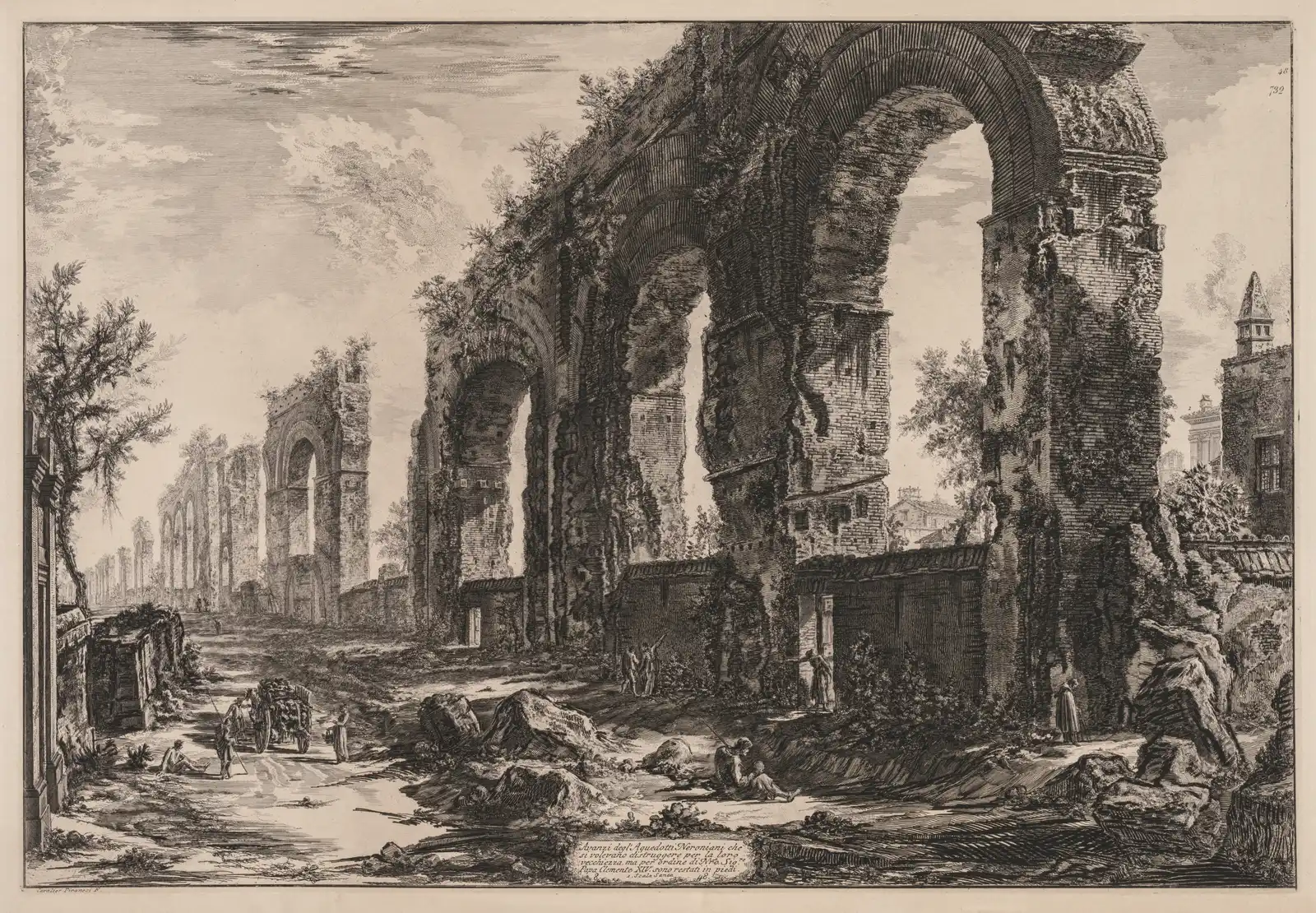
"The Aqueduct of Nero, from Views of Rome" by Giovanni Battista Piranesi — https://commons.wikimedia.org/wiki/File:Giovanni_Battista_Piranesi_-_Views_of_Rome-_The_Aquaduct_of_Nero_-_1921.906_-_Cleveland_Museum_of_Art.jpg — CC0 1.0 (https://creativecommons.org/publicdomain/zero/1.0/)
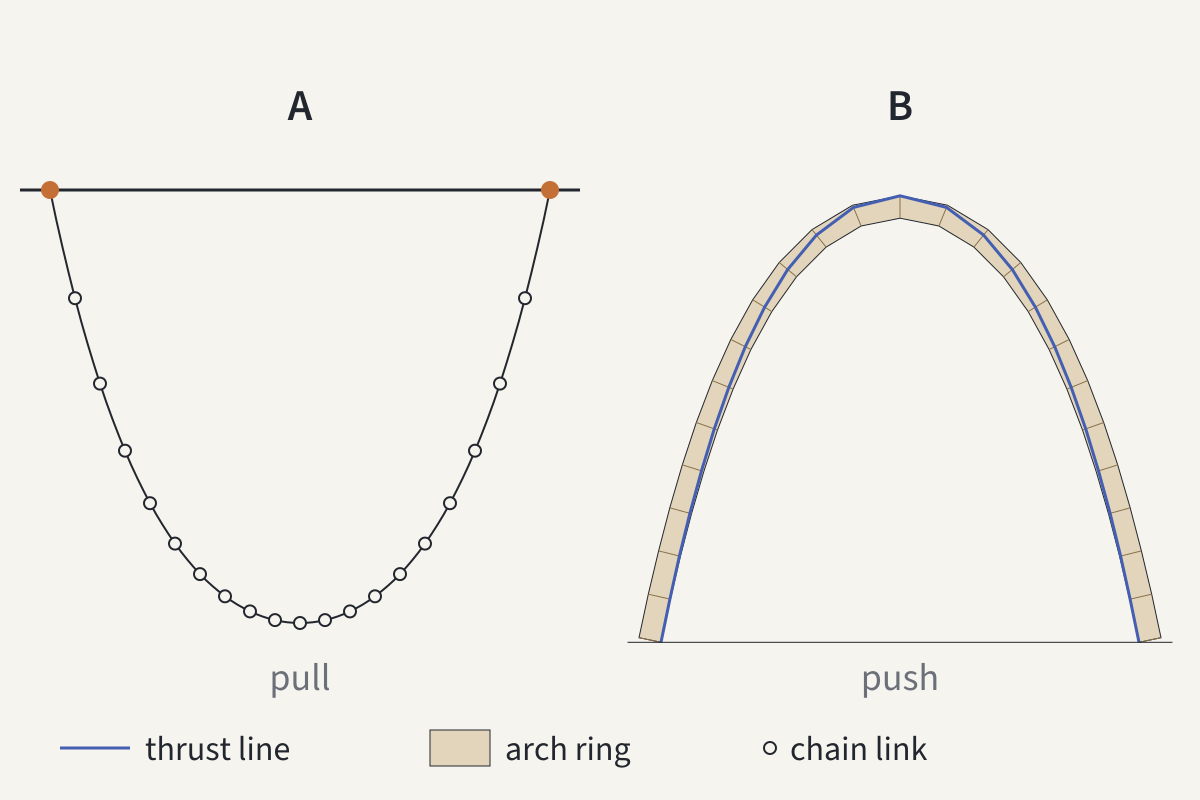
The drawing shows a chain hanging under its own weight and the same curve turned over as an arch ring, with its thrust line inside the stone; the picture is Piranesi's 1775 etching of the ruined arches of the Aqueduct of Nero, from his Views of Rome.
Basis Minimum-thrust line computed for a catenary ring of 24 voussoirs, 0.045 of the span thick, carrying its own weight only.
Legend: letters and numbers on the drawing
- A a chain hanging between two supports
- B the same curve turned over as an arch ring
At the top of many stone archways sits one wedge-shaped stone, wider at the top than below. That stone is the keystone, and the stones on either side of it are voussoirs, the tapered blocks that together make up the curved ring of an arch. Each voussoir presses against its neighbor, so the weight of the whole arch travels around the ring as a push and reaches the ground at both ends. The shape of the curve decides whether that push can stay inside the stone.
Why does an upturned chain make a good arch?
A hanging chain can only pull. Under its own weight it settles into a curve called a catenary, in which every link pulls straight along the direction of the chain. Turned upside down, the same curve changes each pull into a push of the same size. A ring of stones built to the same curve therefore carries its own weight as compression running near its center, which is the one kind of force that separate stones can carry without mortar.
The rule that a hanging chain, turned over, gives the shape of a good arch is usually credited to Robert Hooke. The model on this page tests that rule on a ring of 24 voussoirs carrying only their own weight. It makes three assumptions about the masonry: the stone carries no tension, the blocks do not slide against each other, and the stone does not crush. These are known as Heyman's assumptions, after the structural engineer Jacques Heyman.
Under those assumptions, the model counts an arch as able to stand if a line of thrust, the path the push takes from one stone to the next, fits inside the ring at every joint. For a thin catenary ring, the computed line follows the ring's center closely. In a test case (200 voussoirs, rise half the span, ring 0.05 of the span, the chain's horizontal push), the line strays from the center by at most 0.0034 of the ring's thickness.
Model Model, not a survey of any building; constant ring thickness, self-weight only, no tension, no sliding, stones do not crush (Heyman's three assumptions).
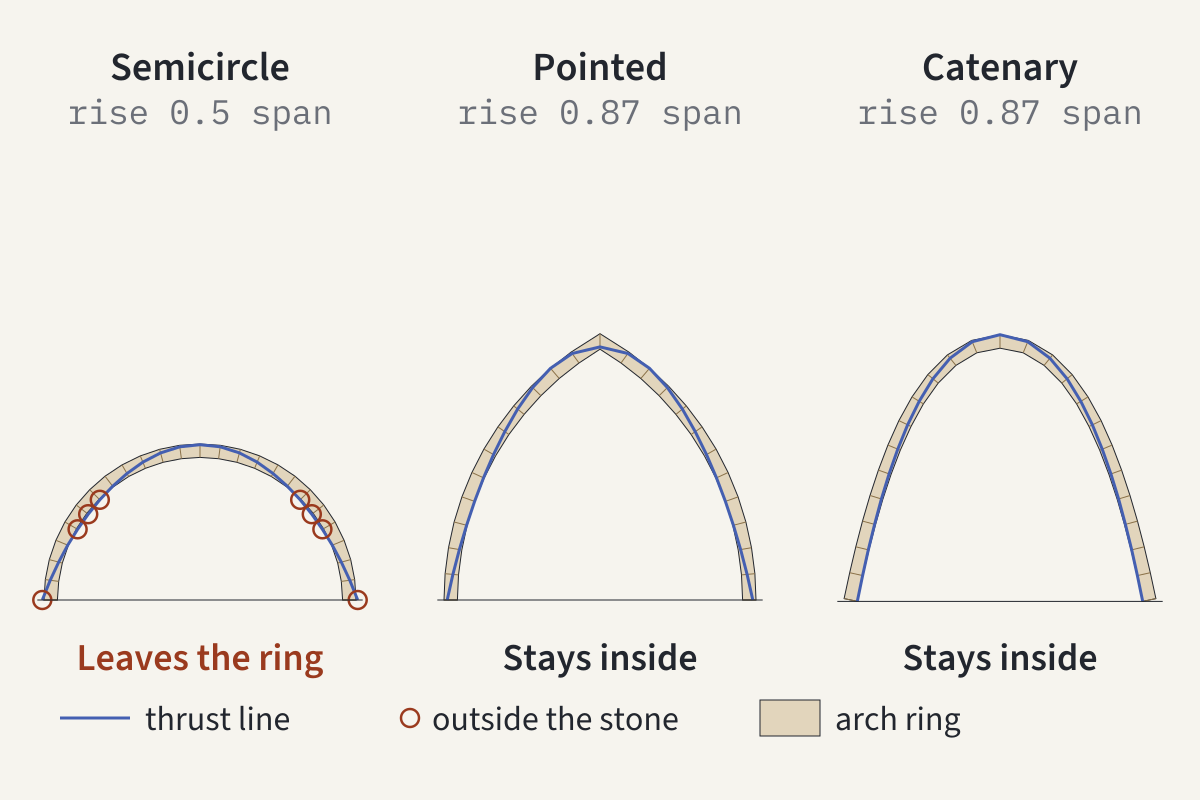
In this model, three rings share one span and one thickness, 0.045 of the span: the thrust line stays inside the pointed and catenary rings but leaves the semicircular ring at the circled joints.
Basis Thrust lines computed for rings of 24 voussoirs carrying their own weight only; minimum-thrust lines where one fits, the closest found where none does.
"Three arch shapes with the same span and ring thickness (model)" by Built, Mapped & Planted, https://builtmappedandplanted.com/structure/catenary-arch/ — CC BY 4.0, https://creativecommons.org/licenses/by/4.0/
In the model, the taller rings need less sideways push: the smallest horizontal thrust that keeps a thrust line inside the ring is 0.175 times the weight of half the arch for the catenary, 0.2179 for the pointed arch and 0.3605 for a semicircle 0.07 of the span thick.
What does the keystone do? This model's ring of 24 voussoirs has a joint at the crown rather than a keystone. With the same shape and load on both sides, that joint carries only a horizontal push. In a keystone arch, with an odd number of stones, the keystone sits on that line and takes that push from both halves.
Try it: does the thrust line stay inside?
The drawing starts with a semicircular ring 0.045 of the span thick, which is the first case in the table. Choose a shape, then drag the thickness slider or type a number, and the model searches for a thrust line that fits inside the ring. Where none fits, circles mark the joints at which the best available line leaves the stone. The table of worked cases remains readable with scripts turned off.
Semicircle, ring 0.045 of the span. No thrust line fits inside this ring: the best line leaves the stone at the circled joints, so this arch would fold.
| Shape | Ring / span | Rise / span | Thrust line fits | Thrust ÷ half weight |
|---|---|---|---|---|
| Semicircle | 0.045 | 0.5 | no | 0.4027 |
| Pointed (two-centered) | 0.045 | 0.866 | yes | 0.2179 |
| Catenary | 0.045 | 0.866 | yes | 0.175 |
| Semicircle | 0.04 | 0.5 | no | 0.4027 |
| Semicircle | 0.07 | 0.5 | yes | 0.3605 |
Model, not a survey of any building: a ring of even thickness carrying only its own weight, with no tension, no sliding and no crushing in the stone. If any line of thrust fits inside the ring, the arch can stand. The worked cases as data (CSV)
"Arch shapes and their thrust lines (model)" by Built, Mapped & Planted, https://builtmappedandplanted.com/structure/catenary-arch/ — CC BY 4.0, https://creativecommons.org/licenses/by/4.0/
Two changes show the effect quickly. A semicircle thickened to 0.07 of the span gives its thrust line enough room to fit, while a catenary holds one even when its ring is made very thin.
How thin can a half-circle arch be?
A semicircular arch has to be thicker than a catenary because its curve departs from the path that the push follows. Near the springing, where the ring meets its supports, and again partway up each side, the best available thrust line passes through the faces of the ring. In the drawing, a ring 0.08 of the radius thick does not pass that test at the circled joints, while a ring 0.14 of the radius thick passes it.
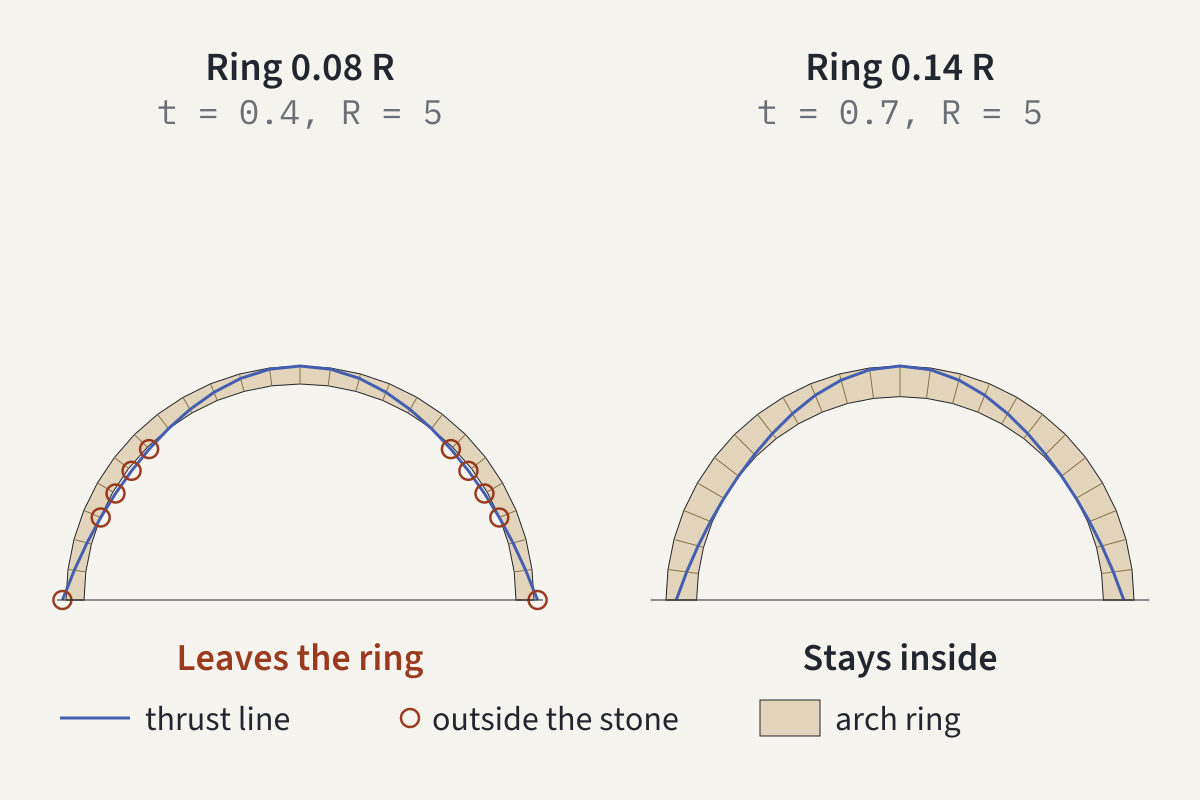
Model Model, not a survey of any building; constant ring thickness, self-weight only, no tension, no sliding, stones do not crush (Heyman's three assumptions).
In this model, two semicircular rings of the same span: at 0.08 of the radius thick no thrust line fits inside, and at 0.14 of the radius the line stays within the stone.
Basis Thrust lines computed for semicircular rings of 24 voussoirs, 0.08 and 0.14 of the radius thick, carrying their own weight only.
"A semicircular arch, thin ring and thick ring (model)" by Built, Mapped & Planted, https://builtmappedandplanted.com/structure/catenary-arch/ — CC BY 4.0, https://creativecommons.org/licenses/by/4.0/
The limit lies somewhere between those two rings. With 400 voussoirs, this site's model puts the thinnest semicircular ring that still holds a thrust line at 0.0537 of the span, or about 0.107 of the radius, and with the 24 voussoirs used in the tool the limit is about 0.054 of the span. These are model results for a ring carrying only its own weight; the model leaves out fill, additional loads, cracks and settlement, so they are not a verdict on any real arch.
Why a pointed arch can be thinner
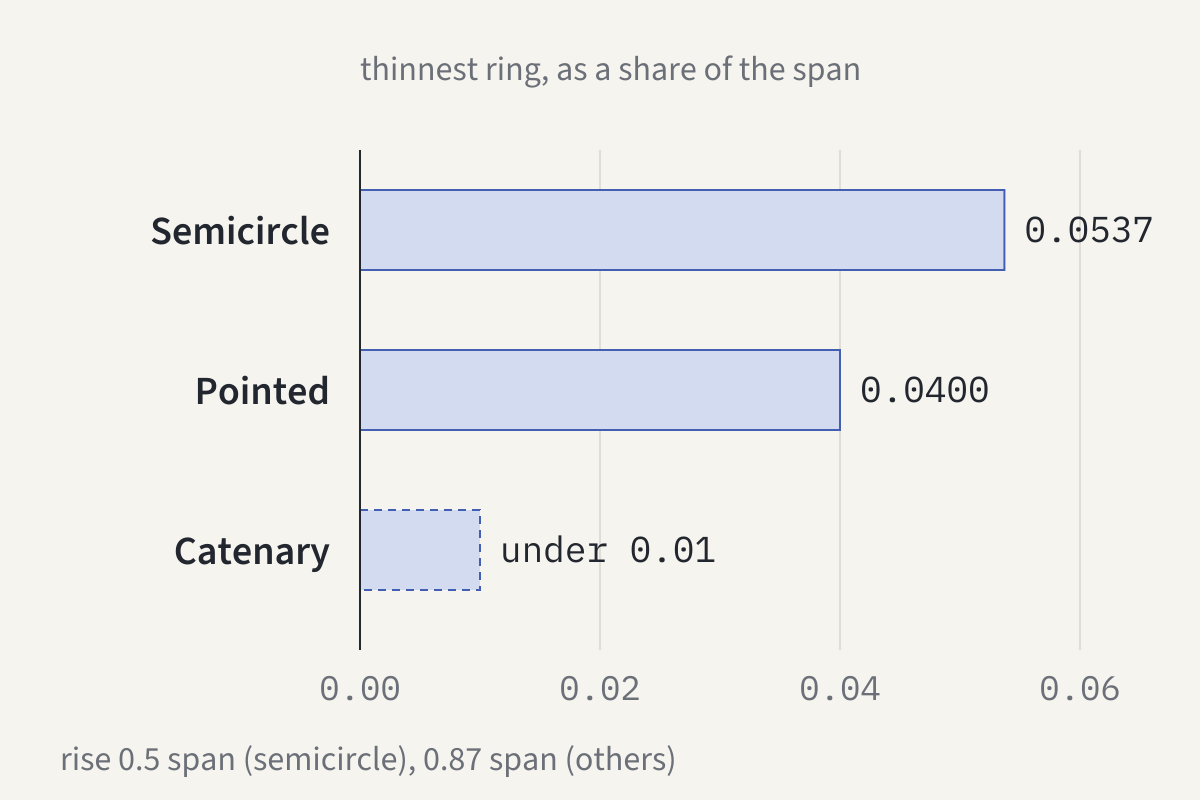
In this model a pointed arch is two circular arcs, centered on the springing line, that meet at the crown, so its rise is more than half its span. The test shape here is the equilateral pointed arch, with a rise of about 0.87 of the span. Its steep sides follow the thrust line more closely than the sides of a semicircle do, as the three-shape drawing above shows.
Model Model, not a survey of any building; constant ring thickness, self-weight only, no tension, no sliding, stones do not crush (Heyman's three assumptions).
In this model, the thinnest ring that still holds a thrust line: 0.0537 of the span for the semicircle, 0.0400 for the equilateral pointed arch, and under 0.01 for a catenary of the same rise.
Basis Thinnest rings found by repeated halving of the thickness, each ring tested across the whole range of horizontal thrust, for rings of 400 voussoirs carrying their own weight only; the pointed result comes out below the semicircle's.
"Thinnest ring that holds a thrust line, three arch shapes (model)" by Built, Mapped & Planted, https://builtmappedandplanted.com/structure/catenary-arch/ — CC BY 4.0, https://creativecommons.org/licenses/by/4.0/
| Shape | Rise ÷ span | Thinnest ring ÷ span (model) |
|---|---|---|
| Semicircle | 0.5 | 0.0537 |
| Equilateral pointed | 0.866 | 0.0400 |
| Catenary | 0.866 | under 0.01 |
In this model the thinnest equilateral pointed ring is 0.0400 of the span, about three quarters of the semicircle's 0.0537, and a catenary of the same rise still holds a thrust line at a ring only 0.01 of the span thick, the thinnest case tested. A dome can be pictured as an arch turned around its vertical axis, and the Pantheon dome page shows how Serlio's proportions fit a whole sphere inside the rotunda. The model assumes separate cut stones, so arches cast in Roman concrete fall outside its assumptions.
Cite this page
Built, Mapped & Planted. “Catenary Arch: An Upturned Hanging Chain Gives the Shape.” First issued 19 November 2026. https://builtmappedandplanted.com/structure/catenary-arch/. Accessed on the day you read it.
Sources
- Jacques Heyman, “The Stone Skeleton,” International Journal of Solids and Structures 2, no. 2 (1966): 249–279. doi.org/10.1016/0020-7683(66)90018-7Read: bibliography only
- Robert Hooke, A Description of Helioscopes, and Some Other Instruments (London: John Martyn, 1676). grubstreetproject.net/publications/R16365Read: bibliography only; the link is a bibliographic record (Grub Street Project), not the text of the book
How numbers and sources are checkedRedline sheet: all correctionsReport an error on this page (contact@builtmappedandplanted.com)
More sheets in How Buildings Stand
S Diagram deep-dive
Flying Buttress: It Carries the Vault’s Push Out to a Pier
Picture credit
"Cathédrale Notre-Dame de Reims, albumen print" by Séraphin-Médéric Mieusement — https://commons.wikimedia.org/wiki/File:Reims_Cathedrale_1490_par_Mieusement.jpg — Public Domain (US: public domain either way: the file page states publication before January 1, 1931 (not traced; the print carries a printed series caption, No 1490), and if unpublished, the photographer died 1905, more than 70 years ago; EU: photographer died 1905, more than 70 years ago (life plus 70 years))
S Diagram deep-dive
Pantheon Dome: By Serlio’s Ratios, a Sphere Fits Inside
Picture credit
"Interior of the Pantheon, Rome, by Giovanni Paolo Panini" by Giovanni Paolo Panini — https://commons.wikimedia.org/wiki/File:Giovanni_Paolo_Panini,_Interior_of_the_Pantheon,_Rome,_c._1734,_NGA_165.jpg — CC0 1.0 (https://creativecommons.org/publicdomain/zero/1.0/)
S Diagram deep-dive
Great Exhibition of 1851: A 24-Foot Grid, an 1851 Book Says
Picture credit
"Crystal Palace from the northeast, from Dickinson's Comprehensive Pictures of the Great Exhibition of 1851" by Dickinson Brothers — https://commons.wikimedia.org/wiki/File:Crystal_Palace_from_the_northeast_from_Dickinson%27s_Comprehensive_Pictures_of_the_Great_Exhibition_of_1851._1854.jpg — Public Domain (US: published before 1931; EU: corporate work (credited to Dickinson Brothers, no individual artist named on the file page) published 1852 to 1854, more than 70 years ago (70 years from publication))